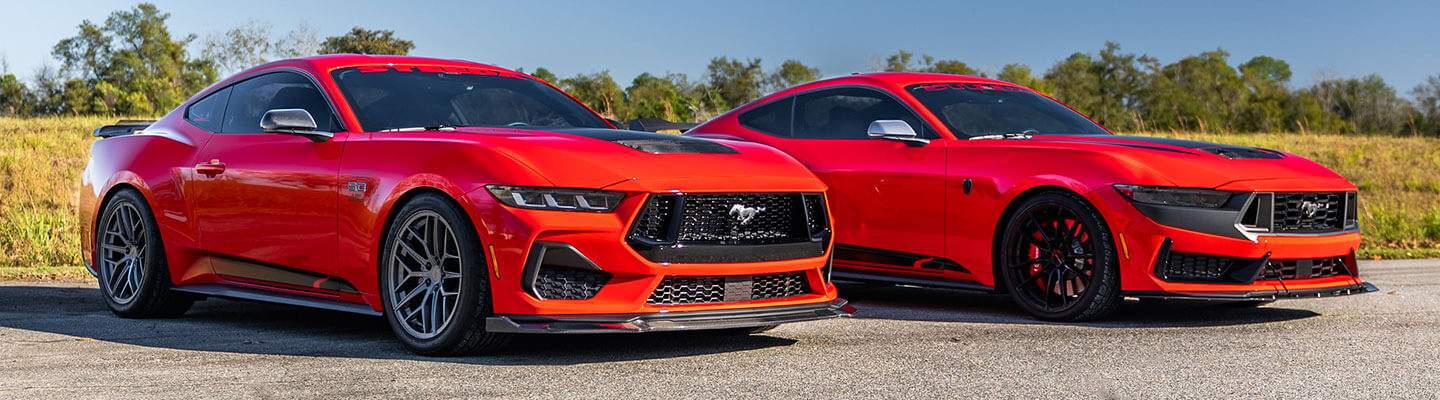
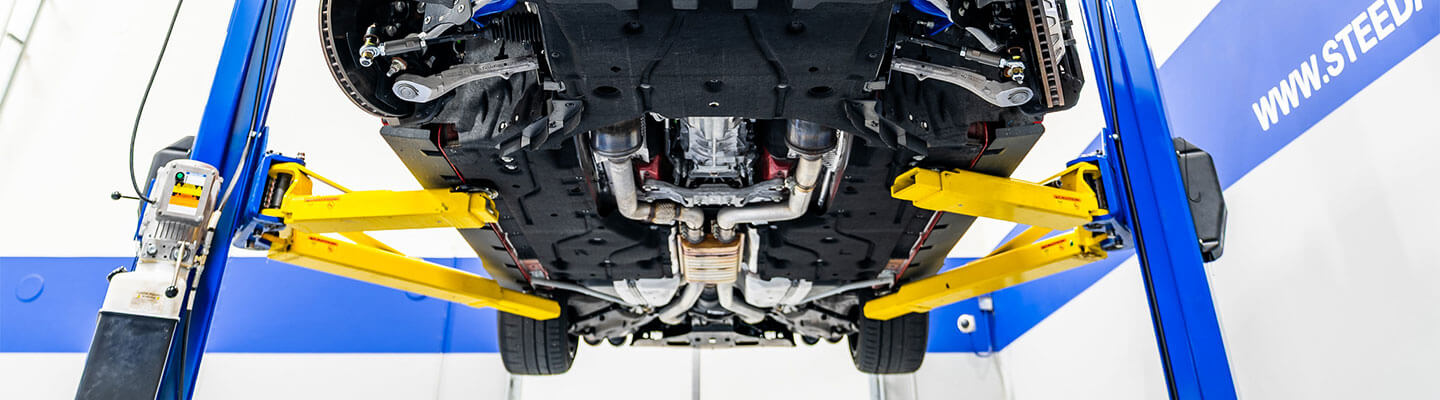
The Mustang Dark Horse takes the S650 Mustang GT’s formula and sharpens it for the track. Both pack the
5.0L Coyote V8, but the Dark Horse makes 500 horsepower thanks to Shelby GT500-spec connecting rods,
stronger internal components, and more aggressive factory tuning, while the GT makes 480-486
horsepower. The Dark Horse is also tailored from the factory for track use, with standard engine,
transmission, and differential cooling, MagneRide dampers, and the big Brembo brakes you’ll only find
on a GT with the Performance Pack.
Dark Horse vs GT at a Glance
Mustang GT / GT Premium
GT with Performance Pack
Dark Horse / Dark Horse Premium
Engine
5.0L Coyote V8 with dual air boxes and dual throttle
bodies
5.0L Coyote V8 with dual air boxes and dual throttle
bodies
Modified 5.0L Coyote V8 with connecting rods
borrowed from the Shelby GT500 and forged internals
Power
480 hp / 415 lb-ft; 486 hp / 418 lb-ft with the Active
Valve Performance Exhaust
480 hp / 415 lb-ft; 486 hp / 418 lb-ft with the Active
Valve Performance Exhaust
18-inch wheels with all-season tires (GT); 19-inch (GT
Premium)
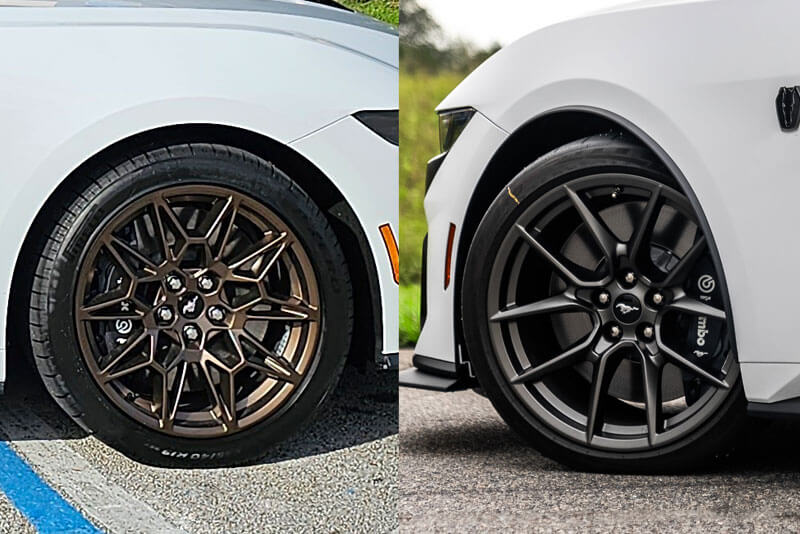
Staggered 19-inch wheels, summer tires
Staggered 19-inch wheels, summer tires; wider
wheels and tires with the Handling Package
Trims
GT (fastback) and GT Premium (fastback or convertible)
Option on GT and GT Premium
Dark Horse and Dark Horse Premium, fastback
only; Dark Horse SC
Ratings and equipment are from Ford’s 2026 Mustang specifications and order
information. For dimensions, weights, gear ratios, and every other trim, see our full 2024-2026 Mustang specs.
The Short Answer: What the Dark Horse Adds Over a GT
A stronger engine delivers more power: 500 horsepower in the Dark Horse, up from the
GT’s 480 to 486, thanks to Shelby GT500-spec connecting rods, stronger internal components, and more
aggressive factory tuning.
A different manual transmission. The Dark Horse uses a TREMEC TR-3160; the GT uses
a Getrag MT-82. For 2026, the 10-speed automatic became the Dark Horse’s standard transmission and
the TREMEC became an option.
Track-ready cooling comes standard: engine oil, transmission, and differential
coolers keep temps in check when you’re pushing hard.
Every Dark Horse comes standard with MagneRide dampers, six-piston Brembo front
brakes, a TORSEN differential, and staggered summer tires. The GT can match most of this hardware,
but only if you check the right Performance Pack boxes.
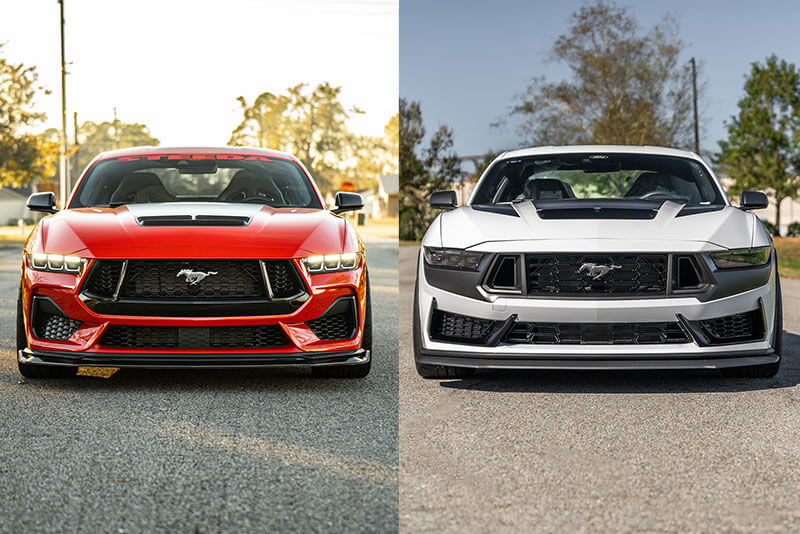
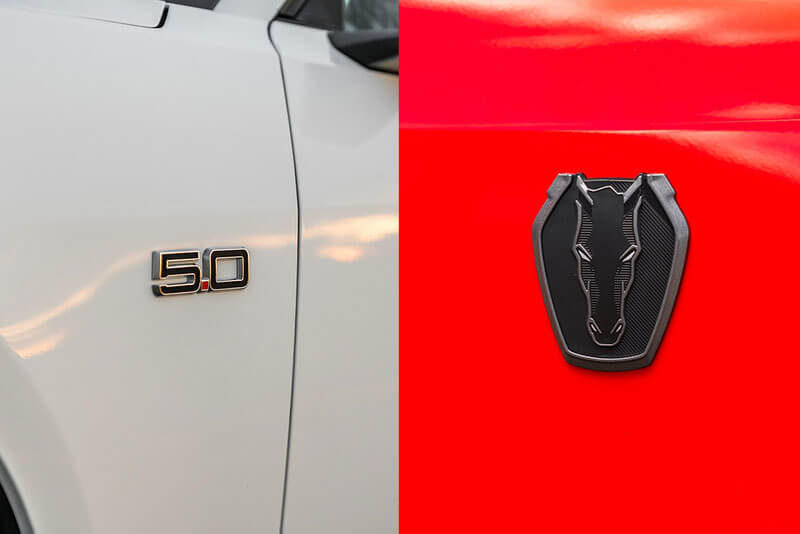
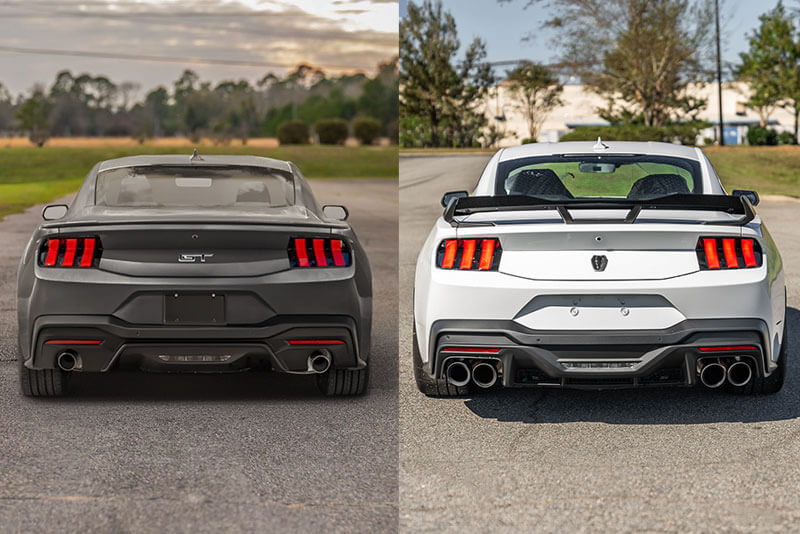
The Dark Horse stands apart visually, with its own grille, hood vent, badging, and
rear spoiler outside, plus blue accent stitching and a suede-trimmed flat-bottom wheel inside.
Engine and Drivetrain
Same 5.0L Family, Different Hardware
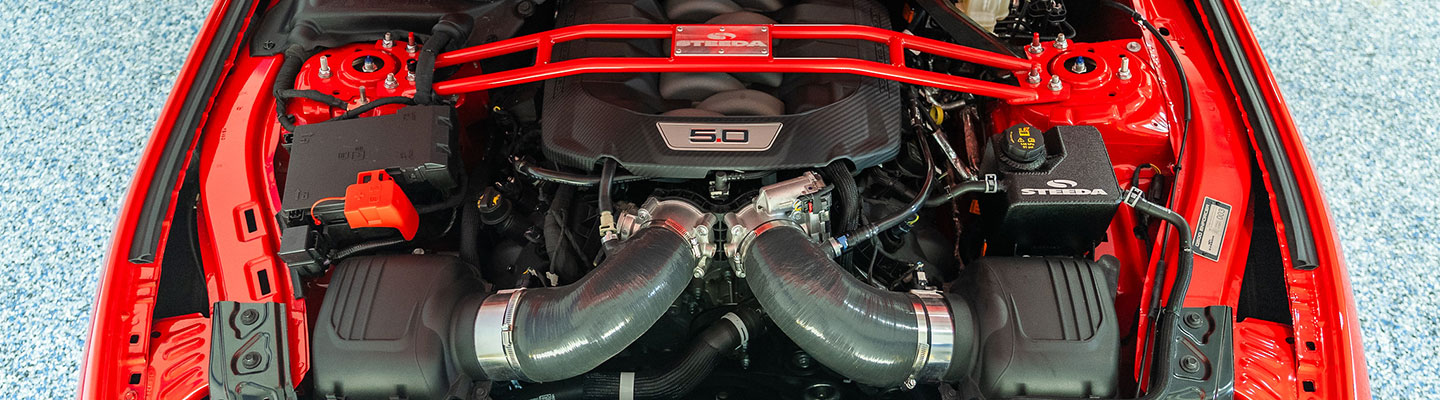
Both cars run the 5.0L Coyote V8 with dual air boxes and dual throttle bodies. Ford rates the GT at 480 hp
and 415 lb-ft, or 486 hp and 418 lb-ft with the optional Active Valve Performance Exhaust. The Dark Horse
is rated at 500 hp and 418 lb-ft, and the active valve exhaust is standard.
Ford calls the Dark Horse engine a modified Coyote. The headline change is a set of Shelby GT500-spec
connecting rods, stronger internal components, and more aggressive factory tuning.
The horsepower gap is small enough that you’ll barely notice it on the street. On a road course, though,
the supporting hardware, cooling, brakes, dampers, and tires set these cars apart.
Manual and Automatic Transmissions
GT and GT Premium: a Getrag MT-82 six-speed manual with rev matching is standard. The
10-speed SelectShift automatic with paddle shifters is optional.
Dark Horse: the manual is a TREMEC TR-3160 six-speed with rev matching and a titanium
shift knob. The 10-speed automatic is the other choice. Which one is standard depends on the year:
2024 and 2025: TREMEC manual standard, automatic optional
2026: automatic standard, TREMEC manual optional
The two manuals use different gear ratios, and aftermarket shifters are built for one or the other. That
matters when you start upgrading (see “Fitment Follows Equipment, Not the Badge”
below).
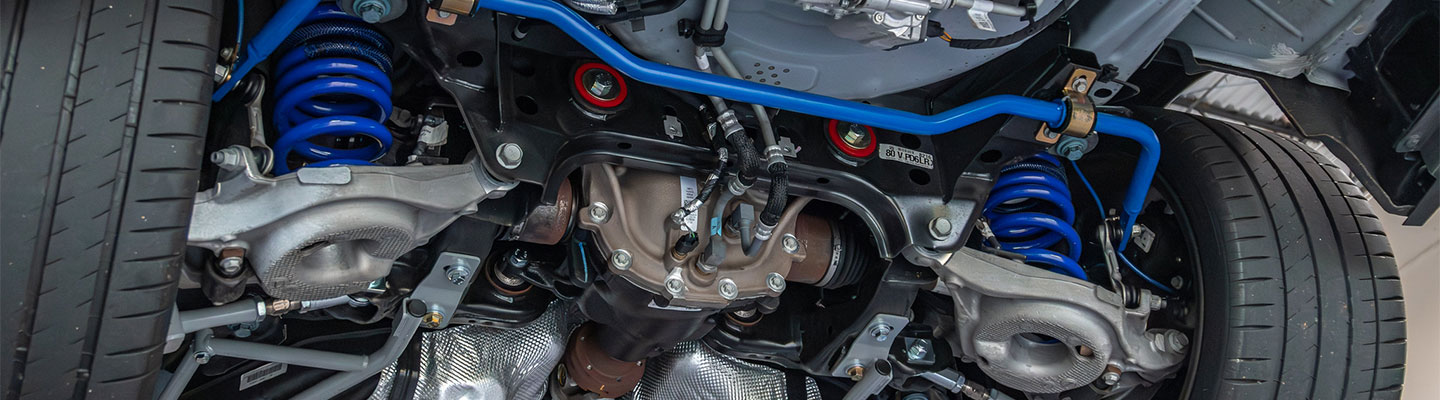
Rear Axle, Differential and Cooling
A standard GT uses a limited-slip rear axle: 3.55 with the manual or 3.15 with the automatic. The GT
Performance Pack swaps in a TORSEN limited-slip differential with a 3.73 ratio (manual) or 3.55
(automatic). Every Dark Horse gets the same TORSEN setup and ratios.
Cooling is where the Dark Horse really stretches its lead. Engine oil, transmission, and differential
coolers come standard, and Ford’s launch materials add NACA brake ducts, a lighter, higher-capacity
radiator, and beefier fans to the list. You won’t spot these upgrades at a glance, but on a hot track
day, they’re some of the most important differences between these cars.
Chassis, Brakes and Tires
Chassis hardware is another big divider. The standard GT and Dark Horse are worlds apart here, but the GT
Performance Pack closes most of the gap by adding the Dark Horse’s Brembo brakes, TORSEN differential,
staggered summer tires, and chassis bracing. MagneRide is optional on Performance Pack cars, but every
Dark Horse gets it standard.
GT Performance Pack vs Dark Horse Handling Package
It’s easy to mix up these two packages since both are billed as the track option, but they serve
different purposes. The Performance Pack transforms a GT into something that can chase a Dark Horse,
while the Handling Package pushes the Dark Horse even further.
GT Performance Pack
Dark Horse Handling Package
Available on
GT and GT Premium
Dark Horse and Dark Horse Premium
Wheels
Staggered 19-inch: 9 in. front, 9.5 in. rear
Wider 19-inch: 10.5 in. front, 11 in. rear
Tires
255/40R19 front, 275/40R19 rear, summer
305/30R19 front, 315/30R19 rear
Brakes
Adds the Brembo system with performance pads
Brembo system already standard
Differential
Adds TORSEN limited-slip
TORSEN already standard
Dampers
MagneRide is a separate option
MagneRide already standard
Aero
Performance raised rear wing (fastback)
Front aero splitter and a rear spoiler with a Gurney
flap
Other
Electronic drift brake, front tow hooks, unique chassis,
steering, ABS and stability tuning
Front tow hooks, revised chassis tuning
Package contents are from Ford’s 2025 and 2026 order information. The
Handling Package’s front splitter ships inside the car for installation after delivery.
Front Fascia: The Dark Horse has its own grille and front bumper, with openings that feed its
intake, plus a unique hood vent.
Badging: The Dark Horse logo replaces the GT badging.
Rear: Every Dark Horse gets a performance rear spoiler painted Tarnish Dark, and the
Handling Package adds a Gurney-flap version. For 2026, the GT has no standard spoiler: the wedge decklid
spoiler and the Performance Pack’s raised rear wing are options. In 2025, the GT came standard with the
wedge spoiler.
Wheels and exhaust: The Dark Horse rides on staggered Tarnished Dark 19-inch wheels and
has black exhaust tips.
GT, GT Premium, Dark Horse and Dark Horse Premium Explained
GT vs GT Premium
The powertrain choices are identical. The difference is comfort, tech, and body style.
GT: fastback only, manually adjusted cloth seats, a six-speaker audio system and
18-inch wheels.
GT Premium: adds six-way power driver and four-way power passenger seats, heated and
cooled front seats with driver memory, a heated steering wheel, a nine-speaker amplified audio system
(Bang & Olufsen 12-speaker optional) and 19-inch wheels. It is also the only GT you can get as a
convertible.
Dark Horse vs Dark Horse Premium
The performance hardware is the same. Dark Horse Premium (Ford’s 700A equipment group) adds heated and
cooled front seats with driver memory, aluminum pedals and puddle lamps, and it is the only Dark Horse
that can order the Dark Horse Appearance Package (Blue Ember Metallic paint, Notorious Blue Brembo
calipers, blue seat accents, a black roof and a hood graphic). Both get the Bang & Olufsen
12-speaker system.
Dark Horse vs GT Premium: The Real Cross-Shop
Spec a GT Premium with the Performance Pack and MagneRide, and you’re surprisingly close to a Dark Horse
where it counts on track: Brembo brakes, TORSEN differential, MagneRide, and staggered summer tires all
make the cut. You also keep the GT Premium’s cooled seats and memory as standard, and you can go topless
with the convertible.
What you can’t get is the Dark Horse’s engine with its extra 14 to 20 horsepower, the TREMEC manual, the
full suite of factory coolers, the unique styling, or the Handling Package. If you’re planning to hit
the track often, those are the reasons to step up. If you drive mostly on the street, a loaded GT
Premium is the more comfortable choice.
For drivers who split their time between street and track, the decision comes down to which trade-offs
matter most. The GT Premium with Performance Pack and MagneRide delivers strong on-road comfort while
staying track-capable, but you may notice some heat-management limitations and won’t get the Dark
Horse’s unique feel or consistency during extended track sessions. The Dark Horse offers extra
performance headroom and durability if you plan to push hard at the track, but you will pay for it with
a stiffer ride and a higher price. Consider how often you’ll use track time and how much daily comfort
you want before you choose.
Which One Should You Buy? The Five-Driver Fit Test
Forget the spec sheet for a minute; start with how you’ll actually use the car. Pick the driver profile
that fits you best.
1. The Daily Driver. You drive it every day, want comfort and tech, and don’t have a
track day on the calendar. Buy a GT Premium. Cooled seats and memory are standard, a
convertible is available, and the standard tires work year-round. Start with lowering springs, a resonator
delete, an H-pipe, and a cold-air intake.
2. The Back-Road Driver. You want a car that feels sharp on a good road and maybe runs
an autocross or two. Buy a GT or GT Premium with the Performance Pack, and add
MagneRide if you can. Choose the Dark Horse instead if you want every factory upgrade at once. Start
with a sway bar kit, camber plates, and our Dual Rate Lowering Springs.
3. The Track Day Regular. You run several HPDE days a season and care about consistent
laps and managing heat. Buy the Dark Horse, and add the Handling Package if you’ll lap
often. The standard coolers, Brembos, TORSEN differential, and MagneRide are built for this. We’ve
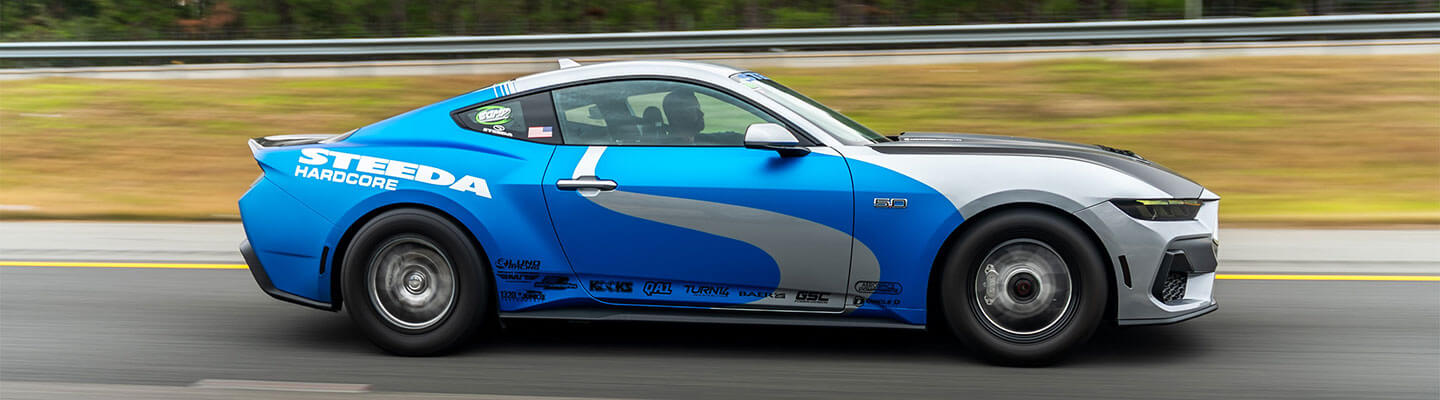
tested this on our Dark Horse R&D car, from a stock baseline at Sebring to the
changes Steeda parts
made on track.
4. The Power Builder. You’re planning a supercharger or big power. Either car
works. Decide by which factory hardware you’ll keep. If you plan to replace the
transmission, axle, and brakes anyway, a GT gives you a lower starting point. If you want the Dark
Horse’s connecting rods and cooling as your base, start there. If you want factory boost, that’s a
different car.
5. The Manual Purist. You want a naturally aspirated V8 with a stick, and you plan to
keep the car. Buy a Dark Horse with the TREMEC. On a 2026, it’s an option, so order it
or check the window sticker. Then add our Tri-Ax short throw shifter
for the TR-3160.
The Dark Horse sits above every GT trim on price. Check Ford’s Build and Price tool for the latest numbers
in your area.
What You Can Do to Each Car at Steeda
We develop S650 parts on our own cars, including a Dark Horse R&D build, so we know exactly how
upgrades break down between the two.
Fitment Follows Equipment, Not the Badge
What fits your Mustang depends more on its factory hardware than the badge on the trunk. Before you order,
check your window sticker for these key details:
Quick tip: You can usually find your window sticker online by searching ‘Ford window sticker lookup’ and
entering your VIN. The sticker will list options like MagneRide, Performance Pack, brake sizes, and
transmission type. If you do not have the sticker, your VIN can help you decode certain features using
tools like Ford’s official VIN decoder or trusted online Mustang VIN guides.
MagneRide or conventional dampers. Our S650 lowering springs come in MagneRide and
non-MagneRide versions. Every Dark Horse has MagneRide. A GT may or may not.
Which manual transmission. The Dark Horse’s TREMEC and the GT’s Getrag need
different shifters.
Which brakes. Brake upgrades built for the Brembo system fit the Dark Horse and a
GT with the Performance Pack, not a GT with the standard brakes.
Underbody aero panels. GT Performance Pack and Dark Horse cars have underbody
panels that must be trimmed or removed to fit our jacking rails.
Coupe or convertible. Several Dark Horse-style spoilers don’t fit convertibles, so
they won’t fit a GT Premium convertible.
You can give a GT the Dark Horse look and make it quicker where it counts. But you can’t turn it into a
true Dark Horse.
The look: largely yes. A Dark Horse-style front bumper, a Handling Package-style
spoiler, and the right wheels get a GT most of the way there visually. It won’t be identical.
The drive? In some ways, yes. Suspension, brakes, tires, a tune, and power adders
can match or even beat certain Dark Horse traits. A GT with the Performance Pack already gets you
Brembos and a TORSEN diff. But the Dark Horse’s engine internals, TREMEC manual, and factory cooling
aren’t practical swaps just yet.
The identity? No. The title and VIN still say GT. If you sell it, call it what it
is: a GT with Dark Horse-style upgrades.
Frequently Asked Questions
What is the difference between the Mustang GT and the Dark Horse?
The Dark Horse is the GT’s track-focused version. It makes 500 hp (up from the GT’s 480-486 hp), uses
connecting rods borrowed from the Shelby GT500, and adds standard engine oil, transmission, and
differential coolers, MagneRide, Brembo brakes, and a TORSEN differential. It also has its own styling
and a TREMEC manual instead of the GT’s Getrag.
Is the Dark Horse faster than the GT?
On a road course, yes. Standard cooling, Brembo brakes, MagneRide, and summer tires let it run hard lap
after lap. In a straight line, the gap is small: the Dark Horse makes 14 to 20 more horsepower, but Ford
also lists it as heavier than a base GT, so acceleration is close.
Is the Dark Horse worth it over the GT?
If you run track days, usually yes, because the coolers, Brembos, TORSEN, and MagneRide come standard. If
you mainly drive on the street, a GT Premium, with the Performance Pack if you want sharper handling,
gives you most of the experience with more comfort features as standard. See the Five-Driver Fit Test above.
What is the difference between the Dark Horse and Dark Horse Premium?
Comfort and convenience, not performance. Dark Horse Premium adds heated and cooled front seats with
driver memory, aluminum pedals, and puddle lamps, and it’s the only Dark Horse eligible for the Dark
Horse Appearance Package.
What is the difference between the Mustang GT and GT Premium?
Both have the same engine and transmission choices. The GT Premium adds power, heated and cooled front
seats with driver memory, a heated steering wheel, upgraded audio and 19-inch wheels, and it’s the only
GT available as a convertible. You can order the GT Performance Pack on both.
Should I buy a Dark Horse or a GT Premium?
Buy the Dark Horse if you’ll track the car often or want the TREMEC manual. Buy the GT Premium if comfort
features and a convertible option matter more. A GT Premium with the Performance Pack and MagneRide
shares the Dark Horse’s brakes, differential, and dampers, but not its engine hardware or coolers.
What does the Dark Horse Handling Package include?
Wider 19-inch wheels (10.5 in. front, 11 in. rear) with 305/30R19 and 315/30R19 tires, adjustable strut
top mounts, front tow hooks, a front aero splitter, a rear spoiler with a Gurney flap, and revised
chassis tuning. If your Dark Horse doesn’t have it, our Handling Package
carbon fiber front splitter and Handling
Package-style spoilers recreate the look.
Can you turn a Mustang GT into a Dark Horse?
You can make a GT look like a Dark Horse with a Dark Horse-style front bumper and spoiler, and suspension,
brake, and power upgrades can match or beat specific Dark Horse traits. The engine internals, TREMEC
transmission, and factory cooling aren’t practical swaps, so it remains a GT.
Build Either One Your Way
Since the GT and Dark Horse share a platform, most of our S650 parts fit both. Let us know what you drive
and how you use it, and we’ll point you to the right upgrades.
Steeda Autosports has built Ford performance parts since 1988. We engineer every product for Ford
vehicles and test it with a team that drives what we build.