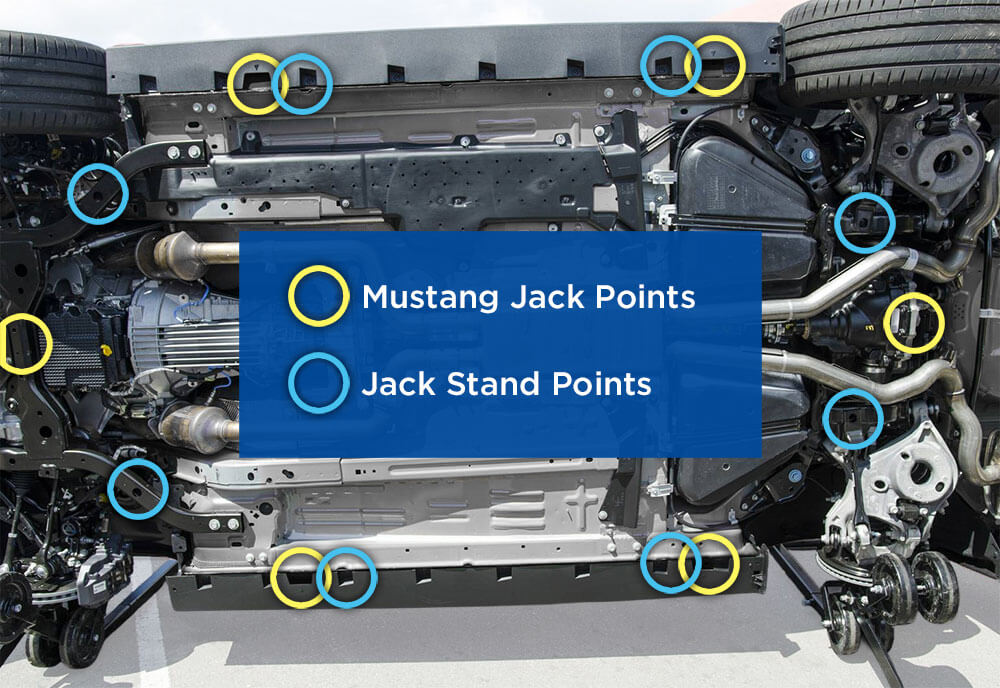
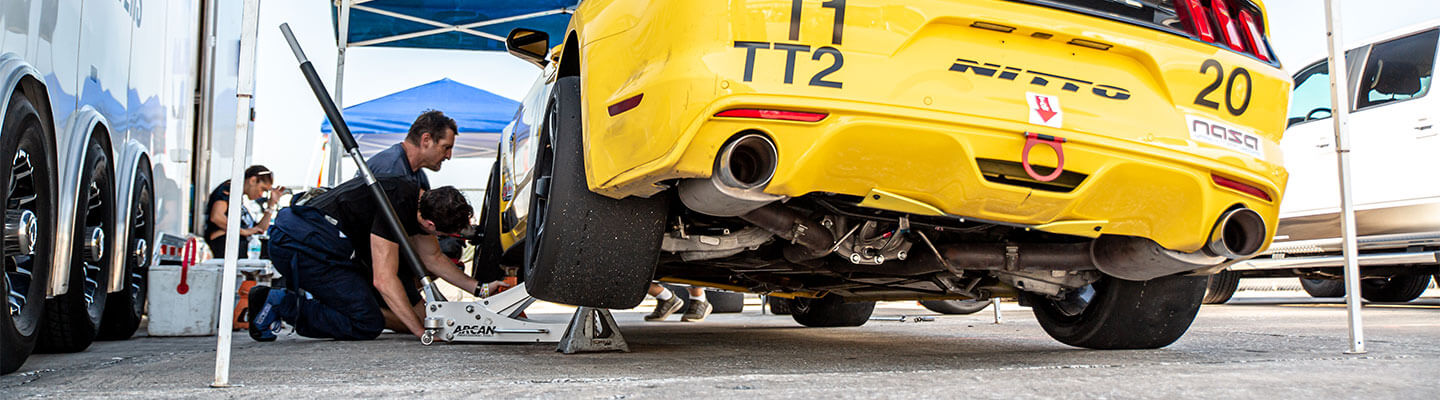
If you crawl under any S197, S550, or S650 Mustang, you'll spot Ford's jack points stamped right into the
pinch weld seam beneath each rocker panel, just behind the front wheel and just ahead of the rear. Look
for the small notches or arrows in the seam; those are your targets for the factory scissor jack. The
trouble is, these spots are all too easy to crush with a floor jack or lift arm. That's where a bolt-in
jacking rail comes in, spreading the load across a sturdy steel tube so you can safely lift or support
your Mustang anywhere along the rocker without risking the pinch weld.
Anyone who's wrenched on their own Mustang has seen the aftermath of a misplaced jack: pinch welds folded
flat, bent outward, or chipped down to bare metal. That seam is what ties your floor to the rocker, and
once it's damaged, rust and headaches follow. In this guide, we'll explain where the jack points are,
why they get mangled, which jacking rail fits your Mustang, and how to get one installed and working.
Where Are the Jack Points on a Mustang?
All three modern Mustang generations use the same basic layout: four factory lift points, two per side,
on the pinch weld.
Generation
Years
Factory Jack Points
Common Problem
Steeda Fix
S197
2005–2014
Pinch weld, behind front wheel / ahead of rear wheel, both
sides
These points are designed for the factory scissor jack. The jack's slotted head straddles the seam and
pushes on the flat metal on either side. A floor jack saddle or a two-post lift pad pushes on the seam
itself.
Why Mustang Pinch Welds Get Damaged
The pinch weld is a thin flange that joins the floor pan to the rocker panel with a line of spot welds.
It's tough when loaded the way Ford intended, but vulnerable from every other angle. Here are the usual
suspects that end up crushing it:
Floor jacks. A round saddle contacts the flange edge-on. Unless you use a slotted
pinch weld adapter and center it perfectly, the flange bends.
Two-post lifts. Shop techs often set lift pads on the seam. Even a slight
misalignment can fold it or crack the paint, which starts rust.
Lowered cars. On a Mustang with lowering springs or coilovers, there may not be
room to get a jack under the jack point, let alone line it up.
A bent pinch weld isn't just an eyesore. Flattened or flared flanges trap water, chipped seams invite
rust, and a badly twisted seam can be a real pain to fix right.
What Jacking Rails Do (and What They Don't)
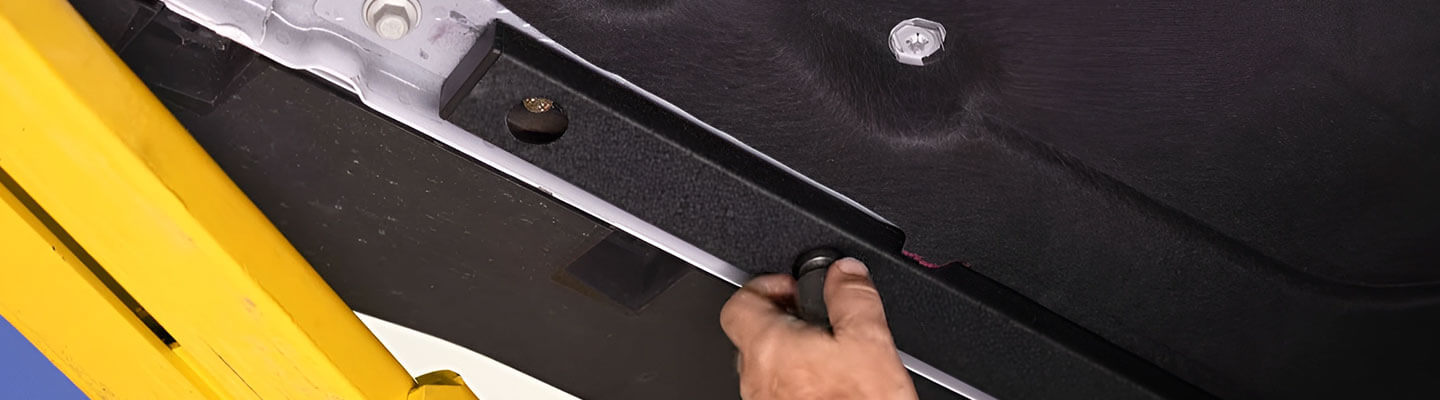
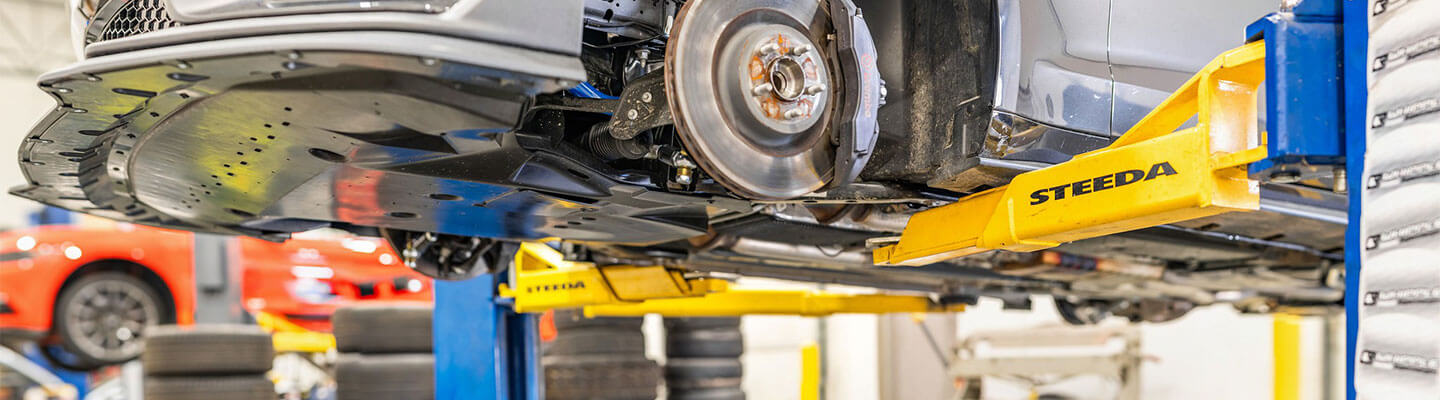
A jacking rail is a steel tube that bolts up under the rocker using the factory mounting points. It tucks
just below the pinch weld, so your jack, stands, or lift arms press on the rail, not the seam.
What they do
Protect the pinch weld by taking the load off the seam entirely.
Let you lift anywhere along the rail, not just at four notches. You can lift the side of the car,
slide a jack stand in next to the jack, and reposition without guessing.
Give two-post lift arms a flat, consistent pad surface.
Make every job easier. Whether you're swapping wheels, tackling brakes, or diving into suspension or
exhaust work, it all starts with safely lifting the car.
They don't replace jack stands. Never work under a car supported only by a jack.
Why Jacking Rails Don't Add Chassis Stiffness
It's a fair question. A jacking rail is a steel tube bolted under the car, so it seems like it should
stiffen something. It doesn't do much, for three reasons.
They run alongside one of the stiffest parts of the body.
The rocker is a closed box section of formed steel that runs between the front and rear wheel openings.
It's one of the strongest structures in a unibody Mustang. A 2" x 1" steel tube bolted beside it is far
smaller than the section it sits next to. It adds very little to how much the body bends or twists.
They don't tie together anything that moves.
A chassis brace works by connecting two points that flex relative to each other under load:
Front and rear frame rails, which is what subframe connectors do
The rear subframe and the body, which is what Steeda 555 5754 Mustang Coupe Rear IRS Subframe
Support Braces (15-26) do
The two strut towers, which is what a strut tower brace does
A jacking rail starts and ends on the same section of rocker. Both mounting points already move together,
so it has nothing to resist.
Which Steeda Jacking Rail Do You Need?
Steeda builds four Mustang jacking rails plus an S650 spacer kit. Here's how to pick:
Your Mustang
Jacking Rail
Part #
Design
Notes
2015–2026 coupe/fastback, want the lightest, lowest option
Low-Profile
555-5205
2" x 1" steel tube, ~12 lbs/pair
Best for heavily lowered cars
2015–2026 coupe/fastback, want the most jacking surface
Full-Length
555-5212
Runs the length of the rocker
More room for a jack and a stand on the same side; passenger rail is
shorter than driver rail
2015–2026 convertible
Convertible Low-Profile
555-5207
2" x 1" steel tube + billet aluminum rear spacers
Keeps the factory convertible bracing in place
2024–2026 S650 coupe (with 5205 or 5212)
Spacer Kit
555-5213
Aluminum spacers
Levels the rail on S650 bodies; ~15-minute add-on
2005–2014 S197 (incl. GT500, BOSS 302)
S197 Low-Profile
555-5209
2" x 1-1/2" steel tube
Clears BOSS 302 quad exhaust; works with 555-5551 brace
Every Steeda Mustang rail is:
Laser-cut and CAD-designed
Finished in wrinkle-black powder coat
Made in the USA
Shipped with zinc-plated, flange-head grade 10.9 hardware
Bolted to factory mounting holes, with no drilling
Low-profile vs. full-length: which is better?
Neither option is stronger where it counts for lifting your Mustang. Both use the same steel tube and
bolt up to the factory mounting points. The real difference comes down to coverage:
Low-Profile (555-5205) is shorter and lighter. It’s perfect if your Mustang is
lowered and you usually lift from the side to swap a wheel.
Full-Length (555-5212) stretches the entire rocker. It gives you space to set the
floor jack in one spot and a jack stand right next to it, exactly what you want when the car’s going
up on four stands for suspension or exhaust work.
S650 (2024+) notes
Spacer kit: On the S650, the rocker mounting surfaces sit differently than on the S550. Without the 555-5213 spacer kit, the rail bolts up
but sits angled slightly inward. Steeda's techs describe a full-length rail with no spacers as acting
like a "hybrid" of the full-length and low-profile designs. For a level jacking surface, run the
spacers.
GT Performance Pack and Dark Horse: These cars have underbody aero panels that need trimming or removal
to fit 555-5205 or 555-5212.
How to Install Steeda Jacking Rails
These rails bolt right in. On a coupe, most folks wrap up the install in 15 to 30 minutes with basic hand
tools.
S550 / S650 coupe (555-5205, 555-5212)
Tools
3/8" drive ratchet
15mm deep socket
torque wrench
scraper (razor or gasket scraper)
blue threadlocker
Instructions
Raise the car or work at ground level. You can install the rails with the car
sitting on the ground and the parking brake set, but jack stands make it easier to see what you’re
doing.
Remove the factory bolts near the pinch weld behind the front jack point and ahead
of the rear jack point. Some cars have an empty threaded hole instead of a bolt. That's normal.
Identify driver and passenger rails. The rails are side-specific; on 555-5212 the
passenger rail is shorter.
If there’s any seam sealer in the way, scrape it off so the rail sits flush against
the body.
S650 only: Install the 555-5213 aluminum spacers between the rail and the body as
shown in the instructions. On GT PP and Dark Horse, trim or remove the underbody panels.
Bolt the rail in with the supplied hardware and torque to spec: 45 ft-lbs.
Support the car on a drive-on lift, two-post lift, or jack stands.
Remove the four 18mm bolts securing the cross brace behind the engine (two per side).
Slide the rail's front bracket under the cross brace and loosely reinstall the factory bolts. You
may need to pry the brace slightly away from the body with a large screwdriver.
Bolt the rear bracket in place with the supplied hardware (15mm).
Tighten the bolts evenly from front to rear so the rail sits flat, then repeat the process on the
other side.
Always use a rubber jack pad. The powder coat is made for padded saddles—a bare
steel saddle will chip the finish.
Lift from the rail, then set your stand right on the rail. With full-length rails,
you can put the jack and stand side by side. With low-profile rails, lift near one end and set the
stand at the other.
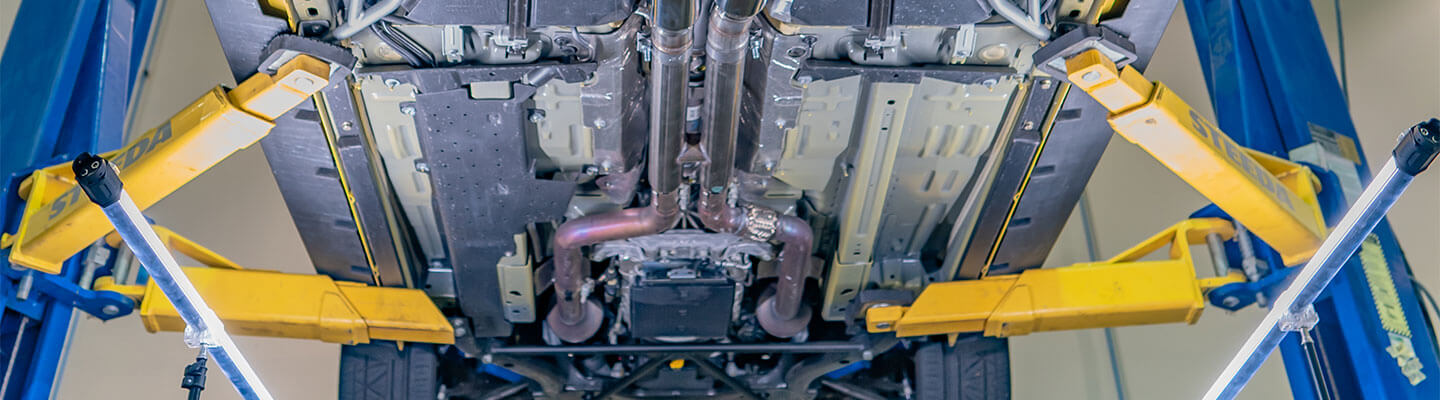
On a two-post lift, set the pads flat on the rails and check that both arms on each
side contact the rail before lifting.
Never get under a car supported only by a jack. Use rated jack stands on level,
solid ground.
Frequently Asked Questions
Do Mustang jacking rails require drilling?
No. Steeda Mustang jacking rails bolt to existing factory mounting holes with the included hardware. You
can remove them at any time.
How much ground clearance do jacking rails take away?
Very little. The rails sit just below the pinch weld, which is already one of the rocker's lowest points.
The low-profile 555-5205 is the best choice for heavily lowered cars.
Which is stronger, low-profile or full-length jacking rails?
Both use the same steel tube and mount the same way, so either can handle a Mustang's weight. The
full-length rail gives you more surface to place a jack and a jack stand on the same side. The
low-profile rail is lighter and tucks up tighter.
Do Steeda jacking rails fit the 2024–2026 Mustang (S650)?
Yes. 555-5205 and 555-5212 fit S650 coupes. Add the 555-5213 spacer kit so the rails sit level. GT
Performance Pack and Dark Horse cars need their underbody panels trimmed or removed.
Do they fit the GT350 and GT500?
Yes. 555-5212 fits S550 GT, EcoBoost and GT350 fastbacks, and 555-5205 also fits the S550 GT500. For
2007–2014 GT500s, use 555-5209.
Will coupe jacking rails fit my Mustang convertible?
No. Convertibles have extra factory bracing under the rear. Use the convertible-specific 555-5207, which
includes billet aluminum spacers to keep the factory bracing in place.
Do jacking rails stiffen the chassis?
Not meaningfully, and they aren't designed to. They're a lifting surface. For chassis stiffness, pair
them with Steeda's IRS subframe support braces (S550/S650) or the 555-5551 brace (S197). Both fit
alongside the rails.
What's the difference between jacking rails and jack pads?
Jack pads (pinch weld adapters) sit on your floor jack and grip the seam. They help, but you still have
to hit the factory point and center the pad every time. Jacking rails mount to the car and turn the
entire rocker area into a lifting surface.