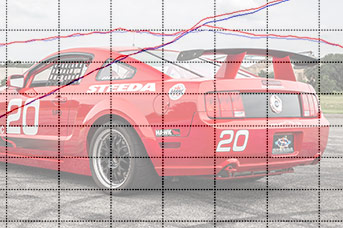
Ask around at any cars and coffee how much horsepower a Shelby GT500 makes, and you'll hear several
different answers. They can all be right, because it depends on the year. Ford's modern GT500 has been
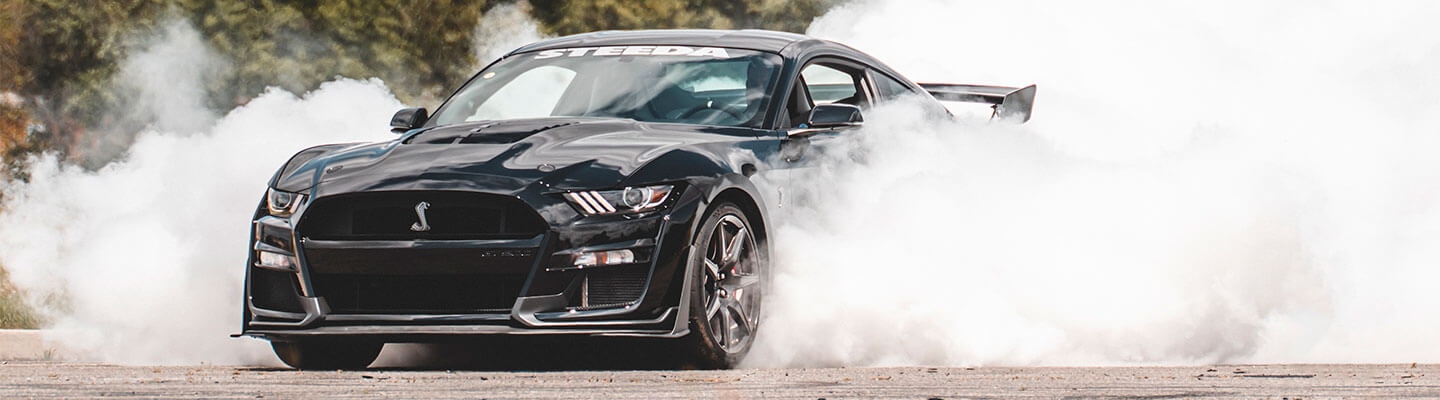
rated anywhere from 500 to 760 horsepower. The top dog is the 2020-2022 GT500, with a supercharged 5.2L
Predator V8 rated at 760 hp and 625 lb-ft. And if you're looking at a 2014, it makes exactly what a 2013
does: 662 hp and 631 lb-ft from the same 5.8L V8.
The fun part is how Ford got there. Every jump came from real hardware: a better cold-air intake, an
aluminum block, a bigger supercharger, then an all-new engine bolted to a dual-clutch. The table below
covers every model year, followed by a walkthrough of each generation.
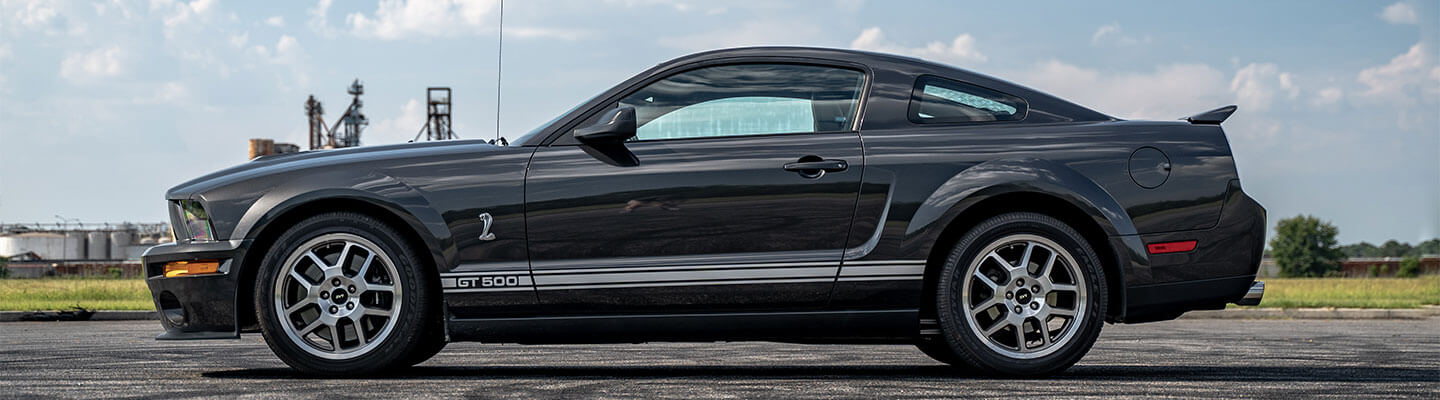
2007-2009 Shelby GT500: The Supercharged 5.4L Brings the Name Back
For 2007, the GT500 badge returned to the Mustang for the first time since 1970, and Ford didn't bring it
back quietly. Final testing put the supercharged 5.4L V8 at 500 hp at 6,000 rpm and 480 lb-ft at 4,500
rpm. That was 25 horsepower more than Ford's own preliminary estimate, and enough for Ford to call it
the most powerful factory-built Mustang yet. The same rating carried through 2009, and it set the
standard for what a modern GT500 meant.
Under the hood sat a 32-valve DOHC 5.4L with an iron block and aluminum heads, built at Ford's Romeo
Engine Plant. It had real pedigree, too: Ford said the four-valve heads, piston rings, and bearings came
from the Ford GT's engine. A Roots-type blower added 9 psi. Since a Roots-type supercharger builds boost
almost right off idle, these cars hit hard from low rpm instead of making you wait for the top of the
tach. Every one came with a six-speed manual and a 3.31:1 final drive.
The 2008-2009 GT500KR
Forty years after the original King of the Road, Ford brought the name back for 2008. Ford's Special
Vehicle Team engineered the GT500KR, and Shelby Automobiles finished it; it got a Ford Racing Power
Upgrade Pack: revised ignition and throttle calibration plus a cold-air intake in place of the stock
unit. Ford estimated the result at 540 hp and 510 lb-ft.
The KR also got a 3.73:1 rear axle, a short-throw shifter, its own suspension tuning, and a carbon
composite hood. You'd feel that axle at every stoplight. A numerically higher ratio multiplies torque at
the rear wheels, so the car pulls harder in every gear, at the cost of a little more rpm on the highway.
2010-2012 Shelby GT500: More Airflow, Then an Aluminum Block
2010: KR Upgrades Make Their Way To Regular GT500
KR's breathing upgrades. Ford credited a recalibration and an improved cold-air intake for bumping output
to 540 hp at 6,200 rpm and 510 lb-ft, 40 hp and 30 lb-ft more than the 2009.
Why does a cold-air intake matter so much on a blown engine? Colder air is denser, so every intake stroke
packs in more oxygen, supporting more fuel and timing before knock shows up. And since the blower heats
the air as it compresses it, cooler air in means a cooler charge out.
Ford reworked the gearing too. Fifth went from 0.80 to 0.74, sixth from 0.63 to 0.50, and the final drive
moved from 3.31 to 3.55. The shorter final drive makes the car quicker in the gears you actually
accelerate in, while the taller overdrives let it lope along at lower rpm on the highway, good for 2
more mpg there by Ford's numbers. The twin-disc clutch also grew, from 215 mm to 250 mm in diameter.
2011-2012: The GT500 Sheds Weight
In 2011, SVT swapped the iron block for an all-new aluminum 5.4L, dropping 102 pounds. Instead of
pressing iron liners into the bores, Ford sprayed a 150-micron plasma-transferred wire arc (PTWA)
coating, saving another 8.5 pounds over a typical steel-sleeved aluminum block. A new 2.75-inch exhaust
with revised tuning added 10 more horsepower, bringing the rating to 550 hp and 510 lb-ft.
Honestly, the horsepower bump is the least interesting part. Pulling 102 pounds off the nose changes how
the car drives. With less mass over the front tires, there's less inertia to fight at turn-in, so the
car reacts more quickly to the wheel and is less eager to push wide. Ford had numbers to back that up: a
2011 coupe with the SVT Performance Package lapped Ford's 2.3-mile test track 3.0 seconds quicker than a
2010.
That package brought Goodyear Eagle F1 SuperCar G:2 tires, lighter wheels, a numerically higher rear axle
ratio, and stiffer springs. The 2011 also moved to electric power-assisted steering, and the 2012
carried it all forward.
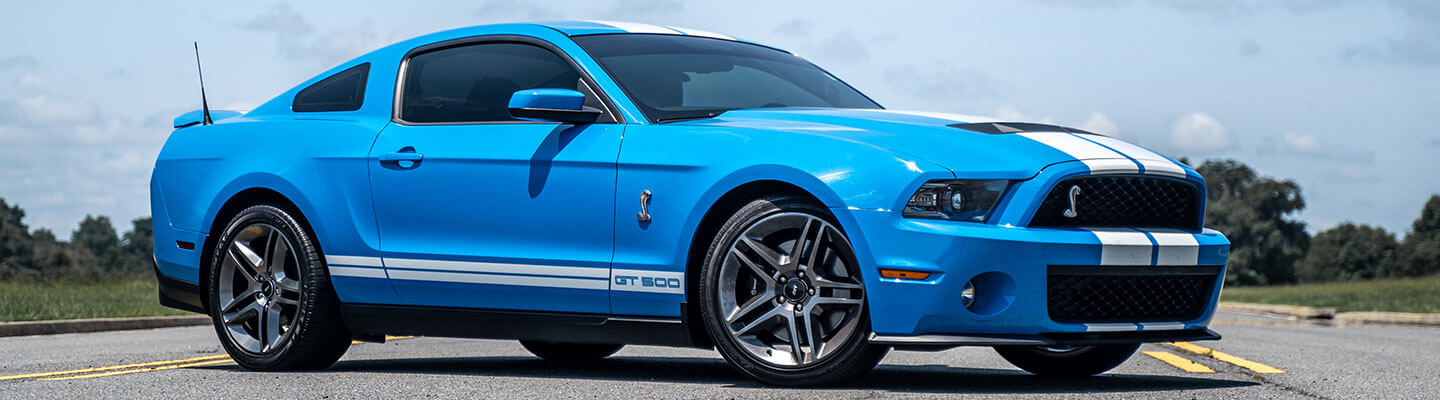
2013-2014 Shelby GT500 Specs: The 5.8L Trinity V8
Here's the short version for anyone shopping: the 2014 Shelby GT500 uses the same supercharged 5.8L
aluminum-block V8 as the 2013, rated at 662 hp and 631 lb-ft. It sends that through a six-speed manual
and a 3.31:1 final drive, and Ford quoted a top speed over 200 mph.
The Trinity actually beat Ford's own promise. When the car debuted in November 2011, Ford was targeting
650 hp and 600 lb-ft. SAE certification came back in April 2012 at 662 and 631, and Ford billed it as
the most powerful series-production V8 in the world at the time. Here's the full 2014 Shelby GT500 spec
sheet. Unless a cell says otherwise, it applies to both years.
2013-2014 Mustang GT500 specs
Specification
2013-2014 Shelby GT500
Engine
5.8L DOHC V8, aluminum block
Bore
93.5 mm (up from 90.5 mm)
Compression Ratio
9.0:1
Supercharger
Twin Vortices Series, 2.3L, four-lobe rotors with 160-degree twist
Peak Boost
14 PSI
Horsepower
662 HP
Torque
631 lb-ft
Transmission
Tremec TR-6060 (6-speed manual)
Clutch
Dual-disc, larger diameter and higher clamp load
Driveshaft
One-Piece Carbon Fiber Driveshaft
Why the Trinity Made 112 More Horsepower Than the 2012
More displacement. Ford opened the bore from 90.5 mm to 93.5 mm, taking the engine
from 5.4 to 5.8 liters. More displacement means more air every revolution before the blower even
gets involved.
A bigger, faster blower. The 2.3L Twin Vortices Series unit spins 2.64 times faster
than its predecessor, and peak boost rose from 9 psi to 14. Ford said inlet air volume went up 33
percent, with nearly 10 percent more injector flow to keep up.
Better heat control. Fourteen psi makes heat, and heat costs power. An intercooler
heat exchanger with 36 percent more volume, a high-capacity fan, and a shroud with pressure-relief
doors keep intake temps in check, so the engine can hold its timing pull after pull instead of
backing off to protect itself.
Torque right off idle. Ford quoted 395 lb-ft at 1,000 rpm, which explains why a
2013 pulls hard long before it nears peak power.
Ford beefed up the driveline to match. A one-piece carbon fiber driveshaft replaced the two-piece steel
shaft and cut rotating mass, and the dual-disc clutch grew in diameter and clamp load. There's a neat
calibration detail, too: an over-rev window lets the engine run to 7,000 rpm for up to eight seconds,
past the normal 6,250 rpm limit, so you can hold a gear when one more shift would cost you time.
This generation has a Hollywood connection we're proud of: the widebody hero car in 2014's Need for Speed
was styled as a 2013 GT500, and Steeda's team built the seven cars used in filming in under ten weeks.
Get the full story on the Need for Speed GT500
Steeda helped build.
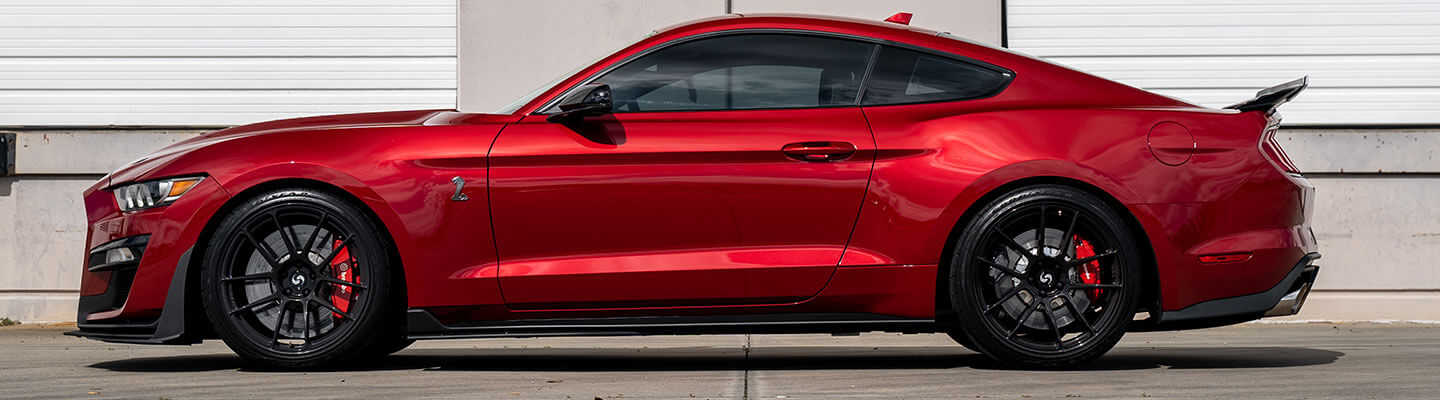
2020-2022 Shelby GT500 Specs: Predator V8 and Dual-Clutch
After five model years, the GT500 returned for 2020 on the S550 platform, and it came back with a
statement. Ford rated it at 760 hp and 625 lb-ft, called it the most powerful street-legal Ford it had
ever built at the time, and said the engine was the most power- and torque-dense supercharged production
V8 in the world.
The 5.2L Predator Makes Its GT500 Debut
The 5.2L Predator is hand-built, with an aluminum block and a structural oil pan that stiffens the bottom
end and uses baffles to keep oil at the pickup when the car is loaded up in a long corner. A 2.65L
Roots-type supercharger with an air-to-liquid intercooler sits in the valley.
If 5.2 liters sounds familiar, it should. The GT350's Voodoo shares the displacement, but it's a
naturally aspirated, flat-plane-crank engine built to rev. The Predator uses a conventional cross-plane
crank, which pairs well with the low-rpm torque a positive-displacement blower makes. (Want to see how
the two Shelbys stack up? Check out our GT500 vs GT350
comparison.)
Carbon Fiber Track Package and Handling Packages
For road-course drivers, the Carbon Fiber Track Package is the box to check. It adds 20-inch carbon fiber
wheels, a carbon rear wing, adjustable strut top mounts, and Michelin Pilot Sport Cup 2 tires. The
wheels are the star: cutting unsprung and rotating mass lets the dampers keep the tire planted over
bumps and takes less energy to spin them up and slow them down.
For 2021, Ford added a middle option, the Carbon Fiber Handling Package, pairing painted carbon wheels
with the Handling Package's adjustable strut top mounts and Gurney flap. However, Ford offered it only
for the 2021 model year.
We Took Our Stock GT500 to the Strip
Our 2020 GT500 R&D car, a Shadow Black Carbon Fiber Track Package coupe, went to South Georgia
Motorsports Park bone stock, still on its factory Cup 2 tires. It ran a 10.73 at 132.9 mph with a
1.74-second 60-foot, with density altitude near 1,000 feet.
That's one car on one day, so call it a data point, not a promise. What jumps out is the 60-foot on
street tires, which shows how cleanly the dual-clutch and traction management put the power down without
slicks. The whole test is on our build page.
2022 Heritage Edition: A Nod to 1967
For its last year, the 2022 Heritage Edition wore Brittany Blue with Wimbledon White stripes (painted or
vinyl) as a tribute to the 1967 original, and Code Orange joined the palette. None of it touched the
drivetrain; the last GT500 made the same 760 hp as the first S550 car.
Is There a New Shelby GT500?
Current as of October 2026.
Not from Ford. GT500 production wrapped up with the 2022 model year, and Ford hasn't put the name on the
S650 Mustang. The closest thing is the 2026 Mustang Dark Horse SC: Ford rates its hand-assembled,
supercharged 5.2L at 795 hp and 660 lb-ft, paired with a Tremec seven-speed dual-clutch. Order banks
opened April 23, 2026.
Shelby GT500 Frequently Asked Questions
How much horsepower does the Shelby GT500 have?
It depends on the year. The 2007-2009 GT500 is rated at 500 hp, the 2010 at 540 hp, the 2011-2012 at 550
hp, the 2013-2014 at 662 hp, and the 2020-2022 at 760 hp.
How much horsepower does a 2014 GT500 have?
The 2014 GT500 is rated at 662 hp and 631 lb-ft from its supercharged 5.8L V8, the same as the 2013.
What is the difference between the 2013 and 2014 Shelby GT500?
Mechanically, they are the same car, with the same engine, rating, and driveline. The differences come
down to colors and option content, so a car’s optional packages matter more than its model year.
Which Shelby GT500 is the most powerful?
The 2020-2022 GT500, rated at 760 hp and 625 lb-ft. At launch, Ford called it the most powerful
street-legal Ford it had ever built.
Did the Shelby GT500 come with an automatic transmission?
The 2007-2014 GT500 was manual-only, with a six-speed. The 2020-2022 GT500 was offered only with a Tremec
seven-speed dual-clutch transmission, which shifts automatically or manually through paddles, with no
traditional torque-converter automatic.
Is there a 2023 or newer Shelby GT500?
No. Ford ended GT500 production with the 2022 model year. The 2026 Mustang Dark Horse SC, rated at 795
hp, fills a similar role in the Mustang lineup but does not carry the GT500 name.