For those looking to push their Coyote 5.0L V8 powered vehicles beyond factory limits, ProCharger stands
as a premier choice for centrifugal supercharging. Unlike traditional positive displacement (PD)
blowers, ProCharger offers a unique power curve that rewards the driver as the RPMs climb, making it the
weapon of choice for street enthusiasts and track veterans alike. For serious track-enthusiasts and those looking to push their Ford, centrifugal superchargers are the
superior choice. Their linear power delivery and superior thermal management allow drivers to maintain
consistent lap times without the heat soak issues common in other designs. When choosing a supercharger, you are really choosing a power delivery philosophy. Positive Displacement (Whipple/Roush): These blowers sit in the engine valley and use
counter-rotating
screws or rotors to trap and move a fixed volume of air per revolution into the intake manifold. While
great for instant "flat" torque and low-end grunt, they often struggle with heat soak and added
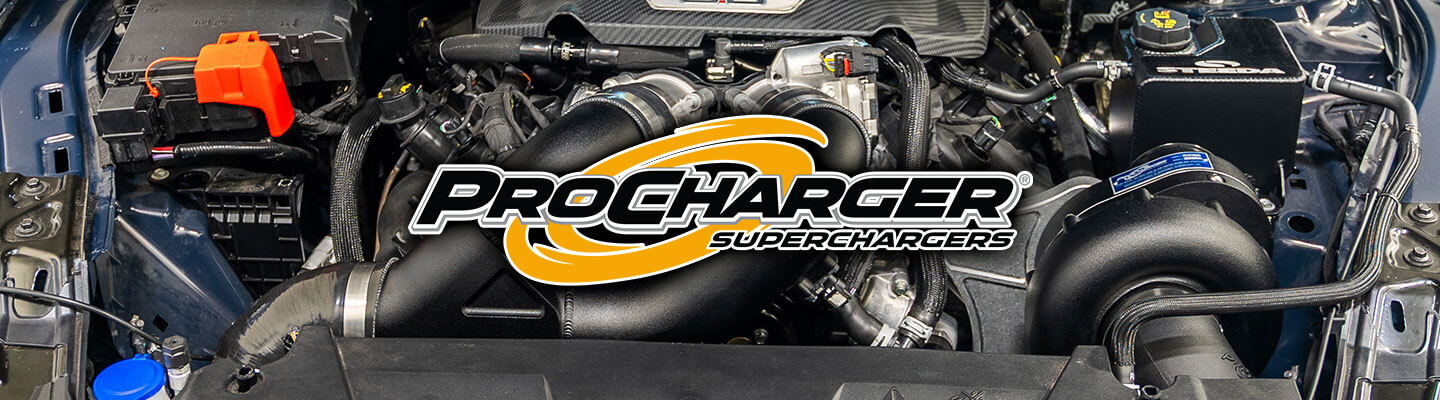
front-end weight. Centrifugal (ProCharger): Think of this as a belt-driven turbocharger. It sits to the
side of the engine,
using a centrifugal impeller to compress air. As engine RPM increases, the impeller spins faster,
drawing in ambient air and using centrifugal force to compress it before reaching the intake manifold.
This creates a linear power curve that builds with engine speed. The dual-throttle body setup of the new Mustang GT and Dark Horse required a complete rethink of forced
induction. ProCharger’s 2026 systems are now shipping with: The S550 remains one of the most popular platforms for ProCharger installation. Our testing on the 2019
Bullitt showcased how the P-1X head unit interacts with the Bullitt’s unique 87mm throttle body and
intake. Case Study: A recent Bullitt build
we did saw massive gains at the top of the tachometer, effectively turning a "cruiser" into
a high-RPM monster. The 5.0L Coyote F-150 is the ultimate "sleeper." Choosing your "head unit" is the most critical decision that you’ll have to make when purchasing a
ProCharger. ProCharger head units are world-renowned for their self-contained lubrication system,
meaning you never have to tap into your Ford’s oil pan. This simplifies installation and ensures the
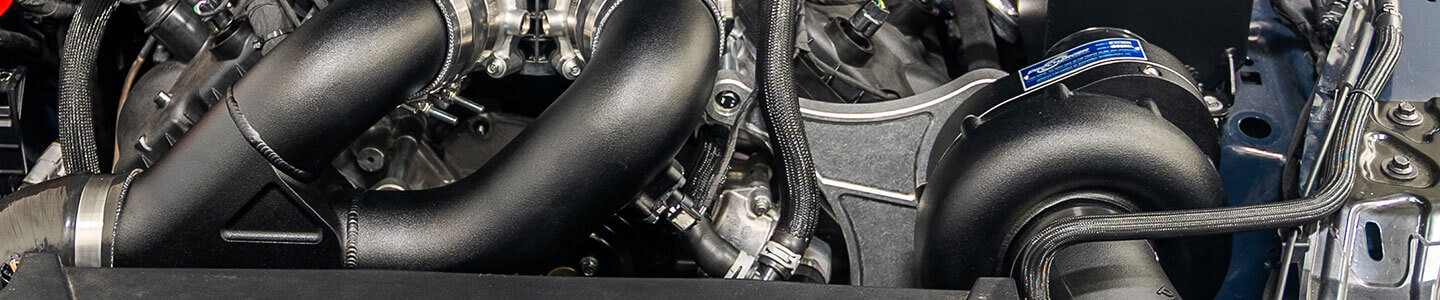
supercharger always has its own dedicated, cool supply of synthetic lubricant. While the P-1SC-1 and D-1SC remains a staple for many builds, the newer "X" Series (P-1X and D-1X)
represents a significant leap in centrifugal engineering. The P-1X and D-1X units aren't just larger versions of their predecessors; they feature a completely
redesigned aerodynamic compressor. A supercharger’s job is to compress air, but a byproduct of compression is heat. To maximize power and
protect your engine, that heat must be removed. ProCharger’s core philosophy centers on Air-to-Air
Intercooling, a cooling process that offers significant advantages over the "two-step"
air-to-water-to-air systems found in most positive displacement blowers. Higher Effectiveness: ProCharger’s air-to-air systems typically achieve 70–80%
effectiveness. In contrast, air-to-water systems suffer from "diminishing returns" because they rely on
two heat exchangers (air-to-water at the engine and water-to-air at the radiator). If each exchanger is
65% effective, the total system effectiveness drops to roughly 49% Rapid Heat Recovery: Because air-to-air intercoolers are exposed to a constant stream of
ambient air, they recover from heat soak almost instantly. As soon as you finish a hard pull and
continue driving, the core temperature drops. Water-based systems hold onto heat much longer due to the
thermal mass of the coolant. Simplicity and Reliability: There are no water pumps to fail, no coolant levels to
check, and no complex plumbing that could leak. This makes the system more reliable for daily driving
and simplifies the installation process. For Ford owners, the choice of intercooler is often dictated by your power goals: Adding 300+ HP to a Ford requires a holistic approach to the vehicle. You must ensure the chassis and
engine can handle the stress of the new power levels. ProCharger prides itself on being "DIY-Friendly." Reliability is a cornerstone of the ProCharger brand. Because these systems are engineered to high
standards, they come backed by several layers of protection. Understanding these warranties is crucial
for any owner looking to balance high performance with long-term peace of mind. Every new ProCharger head unit and system includes a manufacturer’s warranty to ensure the hardware is
free from defects. One of the biggest concerns for owners of newer Ford vehicles is the factory powertrain warranty.
ProCharger addresses this through a partnership with Pinnacle Protect, offering a supplemental
powertrain warranty that covers the engine, transmission, and rear axle. Complete systems are tuned for 91 or 93 octane. If you want to run E85, you will need a "Tuner Kit" and
custom calibration. Yes. Since there is no manifold swapping or engine cutting, you can return the car to 100% stock before a
sale or lease return. You only need to change the supercharger oil every 6,000 miles. It is a simple drain-and-fill process
that takes 15 minutes. Browse our full selection of High-Output and Stage II systems. Find the perfect head unit for your
specific Ford platform.The Ultimate ProCharger Guide For Your Ford
Centrifugal vs. Positive Displacement Superchargers
How ProCharger Transforms Your S550, S650, and F-150
S650 Mustang (2024+)
S550 Mustang (2015–2023)
Ford F-150 5.0L (2021–2026)
Choosing Your ProCharger Head Unit
The "X" Series Advantage
Which Unit Is Right for Your Ford?
Cooling and Airflow: The Air-to-Air Advantage
Choosing Your Intercooler: HO vs. Stage II
Supporting Your Newfound Horse Power
Installation: DIY vs. Professional Shop
Protecting Your Investment: ProCharger Warranty and Powertrain Coverage
Standard Product Warranty
Pinnacle Protect: The Powertrain Warranty
Frequently Asked Questions
Does a ProCharger require a specific type of fuel?
Is it reversible?
What is maintenance like?
Take your Ford to the Next Level