The F-150 already has a front sway bar from the factory, so replacing it might not seem like an obvious
first suspension modification. In many cases, it is not.
But that equation shifts the moment you start dialing in the rear suspension.
Adding a rear sway bar can make an F-150 feel dramatically more controlled through highway ramps, lane
changes, towing maneuvers, and faster corners. But increasing rear roll stiffness also changes the
truck’s handling balance. The rear becomes more willing to rotate, and depending on the setup and road
conditions, that can push the truck toward oversteer.
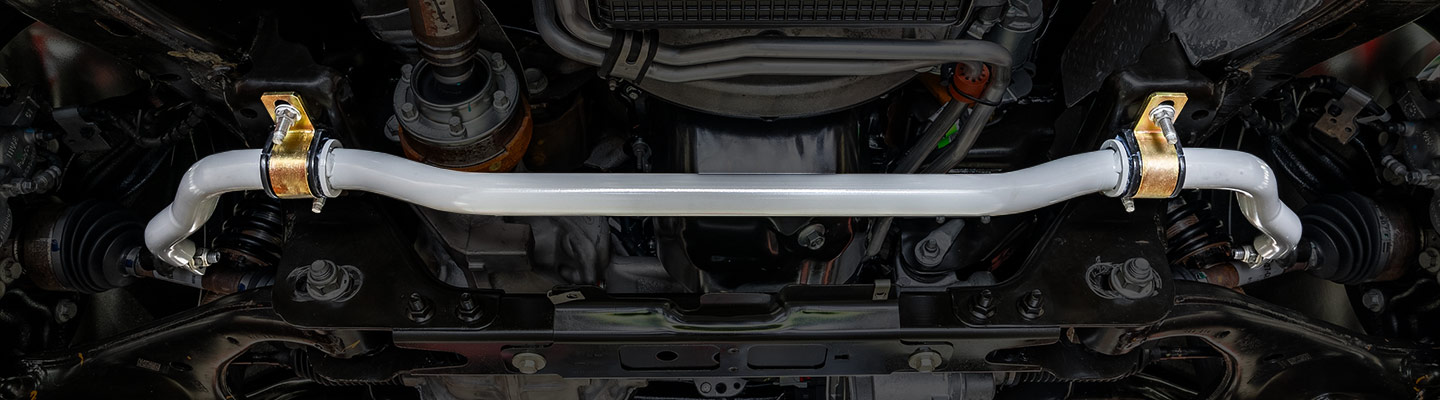
That's why Steeda developed its adjustable F-150 front sway bar. The goal was not simply to make the
front suspension stiffer. It was to give owners another way to tune chassis balance, reduce body roll,
and complement an upgraded rear sway bar without ruining the ride quality that makes an F-150
comfortable every day.
Watch our complete guide for upgrading your F-150's Front Sway Bar
The F-150 Already Has a Front Sway Bar, So Why Replace It?
Unlike the rear suspension on many F-150 configurations, the front suspension comes from Ford with an
anti-roll bar already installed.
That factory setup is designed to work across a huge range of situations. An F-150 might spend Monday
commuting, Saturday towing, and Sunday carrying a bed full of gear. Ford has to account for ride
quality, predictable handling, different payloads, different drivetrains, and a wide range of drivers.
An aftermarket F-150 front sway bar changes that compromise.
It increases front roll stiffness, which helps the truck stay flatter as lateral load builds in a corner.
More importantly, an adjustable bar gives you a way to alter the relationship between front and rear
roll stiffness after other suspension modifications have changed the truck’s balance.
That becomes particularly useful after installing a heavier rear sway bar.
How Sway Bars Actually Change the Way an F-150 Handles
A sway bar, also called an anti-roll bar or stabilizer bar, connects the left and right sides of the
suspension. When both wheels move together, such as over a broad bump, the bar has relatively little
effect. When one side of the suspension moves more than the other, as it does during cornering, the bar
twists and resists that difference.
That resistance reduces body roll.
But body roll is only part of the story.
Changing sway bar stiffness also changes how lateral load transfer is distributed between the front and
rear axles. Because tire grip doesn't increase in perfect proportion to added load, transferring more
cornering load through one axle can reduce the total cornering grip available at that end of the
vehicle.
If worn plugs are already causing misfires, replacing them can restore power the engine had lost. If you
are adding a supercharger, turbocharger, nitrous system, or aggressive calibration, moving to the
appropriate colder plug can give the engine the thermal margin it needs.
That gives us one of the fundamental rules of suspension tuning:
Sway Bar Change
Typical Handling Effect
Increase front roll stiffness
More understeer tendency
Increase rear roll stiffness
More oversteer tendency
Balance front and rear stiffness
More neutral, predictable response
This is why sway bars should be treated as chassis tuning components rather than simply body-roll
reducers.
A truck can be very flat and still have poor handling balance. The objective is to control body motion
while keeping the front and rear axles working together predictably.
Why a Rear Sway Bar Changes the Equation
For many F-150 owners, a rear sway bar is the first major handling upgrade.
That makes sense. Most configurations do not use a conventional rear sway bar from the factory, so adding
one can make a substantial difference in how much the body moves during cornering and quick transitions.
Certain towing-focused configurations can differ, but for many owners, the rear bar is effectively
filling a gap in the factory chassis.
Steeda’s adjustable rear sway bar is popular for exactly that reason.
The truck feels more tied together. Body roll decreases. Highway transitions become cleaner. The chassis
can also feel more controlled when towing or carrying weight.
The important part is what happens to the overall balance.
Increasing rear roll stiffness means the rear axle takes a greater share of the truck’s lateral load
transfer. At the limit, that reduces rear grip relative to the front and increases the truck’s tendency
to rotate.
That is oversteer.
In normal street driving, a properly configured rear bar does not mean the back of the truck is suddenly
going to step out every time you turn the steering wheel. It does mean that the front-to-rear balance
has shifted.
That shift becomes more important on wet pavement, during abrupt transitions, or as you push closer to
the available grip.
The Front Bar Helps Bring the Chassis Back Into Balance
Ford gives the F-150 predictable handling characteristics from the factory, including some understeer as
the truck approaches its limits. That means the front tires tend to run out of cornering grip before the
rear tires.
Adding substantial rear roll stiffness can reduce that built-in understeer and move the chassis toward a
more neutral balance. Go far enough, however, and the rear can become too active.
The Steeda F-150 front sway bar gives you a way to move the balance back toward the front.
Increasing front roll stiffness creates more understeer, which can counter the additional oversteer
introduced by a stiffer rear bar. When matched properly, the result is a truck that corners flatter
without feeling excessively loose from the rear or unwilling to turn from the front.
That balance is the real reason for the upgrade.
Steeda Gives the F-150 Two Front Sway Bar Settings
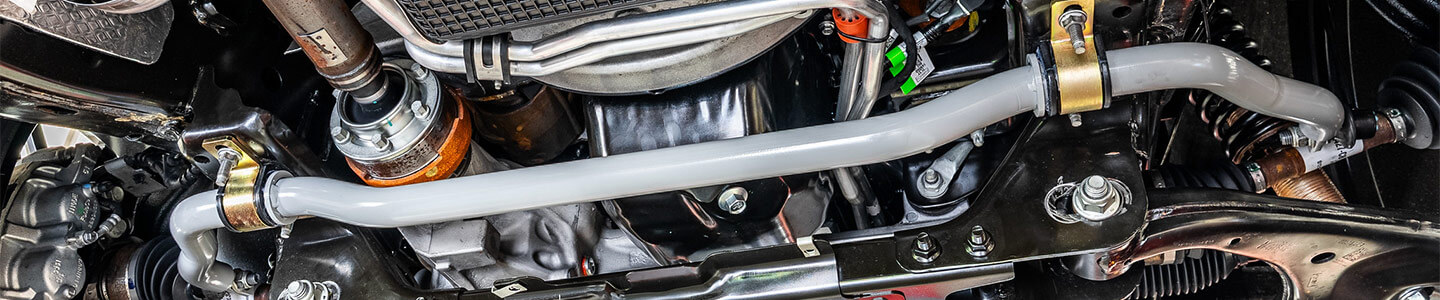
Steeda uses a two-hole adjustment design on its F-150 front sway bar.
That differs from the three-hole adjustment found on Steeda’s rear F-150 bar and several other Steeda
sway bar applications. The reason comes down to clearance.
F-150s can be found in two-wheel-drive and four-wheel-drive configurations, at stock ride height,
lowered, or lifted. Adding a third adjustment position to the front bar could create clearance issues
with some of those combinations.
The two-hole design maintains meaningful adjustment while giving the bar room to work across a broader
range of F-150 setups.
Both positions are stiffer than the factory front bar.
Front Setting
Stiffness Increase vs. Factory
Best Starting Point
Outer hole
33%
Recommended for most installations
Inner hole
52%
More front roll stiffness and less body roll
Steeda recommends starting with the softer outer position.
That matters because the stiffest setting is not automatically the best setting. Sway bar tuning should
be based on the complete truck, including rear bar position, tires, ride height, suspension
modifications, payload, and how the vehicle is actually used.
Start soft, drive the truck, then make a change if the chassis needs it.
The Bar Was Developed Around More Than Diameter
The Steeda F-150 front sway bar starts with domestically sourced 1 3/8-inch steel tubing. The tubing is
bent in Valdosta, Georgia, using Steeda’s CNC tube bender.
Billet 1018 steel ends are welded into the bar before the assembly is powder-coated. The kit also uses
urethane bushings and stamped-steel brackets manufactured to Steeda’s specifications.
Those details matter because sway bar stiffness is not determined by outside diameter alone.
Tubing diameter, wall thickness, arm length, lever geometry, material, and adjustment-hole location all
affect how much resistance the bar creates.
Steeda tested multiple wall thicknesses while developing the F-150 front sway bar. According to the
video, they selected the final combination because it delivered the desired body control and handling
balance without creating an unnecessary ride-quality penalty.
That is an important distinction. Maximum stiffness was not the target. A better-balanced F-150 was.
Does a Stiffer Front Sway Bar Hurt Ride Quality?
This is one of the biggest concerns with any handling modification on a truck.
Springs and sway bars do different jobs.
A significantly stiffer spring affects suspension movement whenever that corner of the truck moves
vertically. A sway bar primarily comes into play when one side of the suspension is moving differently
from the other.
That is why an appropriately tuned sway bar can substantially reduce roll without making the truck ride
like it has received a huge increase in spring rate.
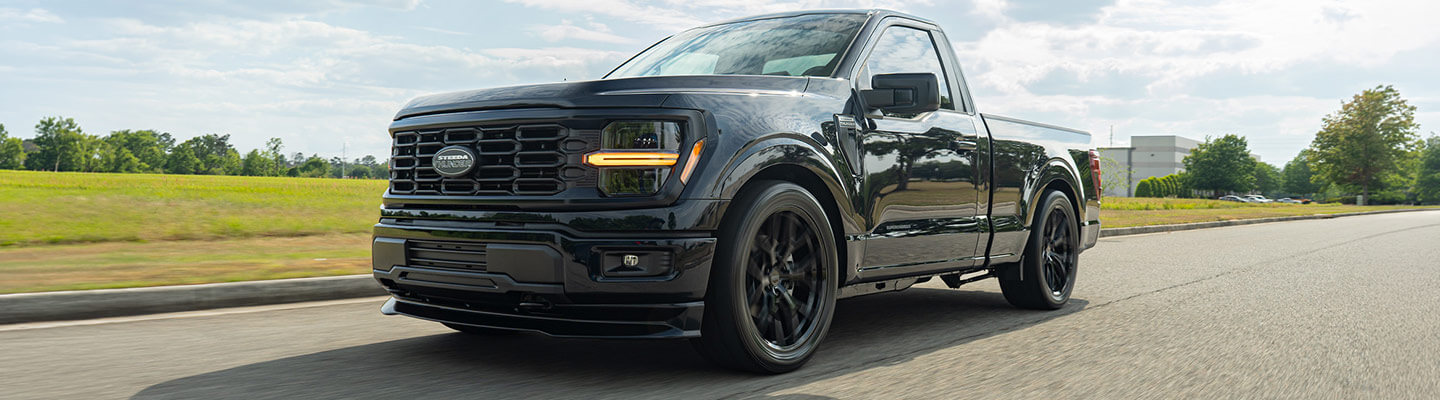
Steeda’s driving impressions after installing the bar reflect that goal. During the video, the truck
stays impressively flat through faster corners and a roundabout, while the ride is described as largely
unchanged.
That is exactly what you want from this type of upgrade.
The F-150 feels more controlled when lateral forces build, but it still behaves like an F-150 during
normal driving.
What About Towing?
Sway bars can be useful on a truck that regularly tows, but it is important to separate two different
types of “sway.”
An F-150 suspension sway bar controls body roll. Ford’s Trailer Sway Control is an electronic
vehicle-control system designed to react when trailer movement becomes unstable.
They are not the same system, and one does not replace the other.
A heavier suspension sway bar can make the truck itself feel more planted during highway transitions and
directional changes. That can improve driver confidence, especially with a load behind the truck.
It does not correct an improperly loaded trailer.
Trailer stability still depends heavily on proper tongue weight, loading, tire condition, hitch setup,
and the correct use of a weight-distribution hitch when the application calls for one. An upgraded
suspension should be viewed as another layer of chassis control, not as a fix for poor trailer setup.
Installation Is Refreshingly Straightforward
The front sway bar installation shown in Steeda’s video is relatively simple because it uses the factory
mounting locations.
Removal starts with the factory sway bar brackets and end links. The bracket hardware uses 15 mm
fasteners, while the end link nuts require a 21 mm tool.
After removing the factory bar, install the Steeda bar with the center section angled downward. Apply the
supplied grease to the inside of the urethane bushings and along the bushing surfaces that contact the
sway bar stops.
Bring the brackets into position and tighten evenly.
The important final torque specifications are:
Fastener
Torque Specification
Sway bar bracket hardware
46 ft-lb
End link hardware
111 ft-lb
Hold the end link stud while tightening so it does not rotate.
Because the installation uses the existing chassis mounting points and factory-style end-link locations,
this is a suspension upgrade that an experienced DIY owner can approach without tearing apart the rest
of the front suspension.
Who Actually Benefits From an F-150 Front Sway Bar?
Not every F-150 needs an upgraded front bar.
The modification makes the strongest case on trucks where the rest of the suspension, or how the truck is
used, gives the added roll stiffness a clear job to do.
The best candidates include:
F-150s already equipped with an aftermarket rear sway bar.
Street-driven trucks where reduced body roll and more precise transitions are priorities.
Trucks that regularly tow and would benefit from additional chassis control during lane changes and
highway ramps.
Lowered or handling-focused F-150 builds where front-to-rear suspension balance matters more than
maximum articulation.
An off-road-first build deserves different priorities.
More sway bar stiffness means the left and right sides of the suspension are more strongly coupled. That
helps on pavement, but added coupling can work against wheel articulation on uneven trails.
If maximum suspension articulation is the primary goal, a stiffer sway bar may not be the first
modification to pursue.
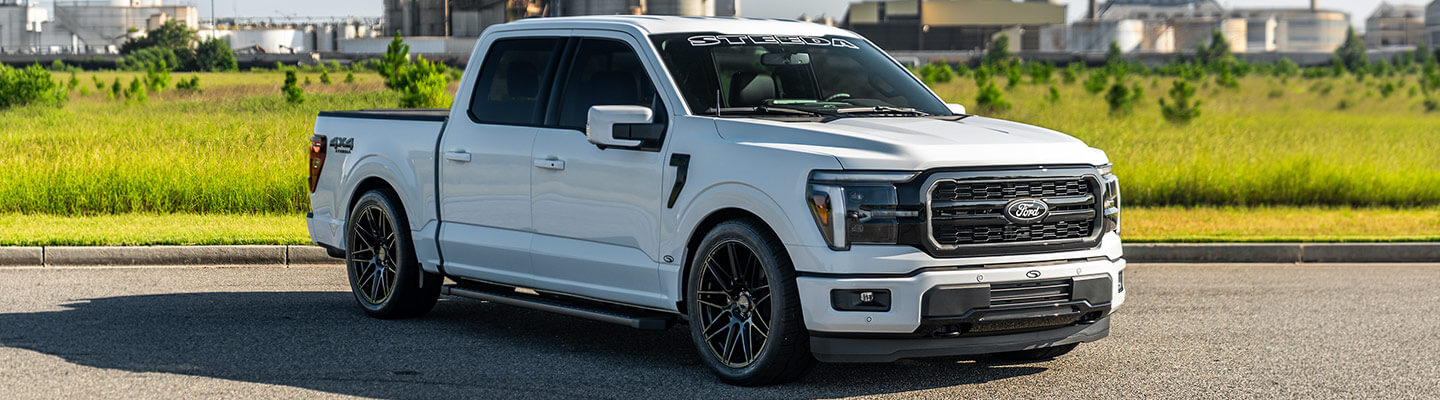
Steeda’s new front sway bar is designed for 2021 and newer F-150 applications in both two-wheel-drive and
four-wheel-drive configurations, excluding the Raptor.
Front and Rear Sway Bars Should Be Tuned as a Package
The biggest lesson from Steeda’s development video is not simply that a bigger front sway bar makes an
F-150 corner flatter.
It is that chassis balance matters.
Install a heavier rear sway bar and the truck’s handling changes. Increase front roll stiffness, and it
changes again. The job is to use those adjustments together so the F-150 responds consistently from
initial turn-in through the middle of the corner.
That is why Steeda recommends beginning with the softer front setting rather than automatically moving to
maximum stiffness.
Drive the truck on roads you know. Pay attention to how quickly the body takes a set, how much steering
input is required, and whether the rear feels more or less active through transitions. From there, the
adjustable bars let you fine-tune the truck rather than forcing you into one fixed setup.
So, Does Your F-150 Need a Front Sway Bar?
If your F-150 is stock, the factory front sway bar already provides the roll control Ford intended for a
broad range of everyday uses. There is no reason to replace parts simply for the sake of replacing them.
The answer becomes much clearer once the truck has an upgraded rear sway bar or the owner wants a more
handling-focused setup.
Steeda’s adjustable F-150 front sway bar adds 33% or 52% more stiffness than the factory setup, reduces
body roll, and gives you another tool for controlling front-to-rear handling balance. Paired with the
rear bar, it lets the suspension work as a complete system rather than putting most of the added roll
stiffness at one end of the truck.
That is what makes the front bar worthwhile.
The objective is not simply a stiffer F-150. It is a truck that stays flatter, reacts more predictably,
and feels properly balanced when you ask more of the chassis.