Horsepower sits at the heart of what makes a Mustang special, but for many owners, the thrill of a
naturally aspirated Coyote only lasts so long before the itch for more sets in. When that happens,
forced induction is the go-to move, and nothing delivers big, reliable, seat-of-the-pants power quite
like a supercharger. Forget turbo lag, superchargers hit hard and fast, with proven kits ready for
everything from SN95s and New Edges to S197s, S550s, and the latest S650 and Dark Horse models. But not all superchargers are built the same. When you start shopping, you'll find three main types:
Roots, twin-screw, and centrifugal, each with its own way of making power and its own personality. The
best choice depends on how you drive, your power goals, and the kind of boost curve you want to feel in
the seat. Here's how each one stacks up, what you gain, what you give up, and which fits your Mustang
best.
Quick Comparison
Supercharger Types
Supercharger Pros & Cons
Supercharger Usage
Every supercharger shares the same mission: cram more air into the engine than it could ever pull in
naturally, letting you burn more fuel and unlock more power. What sets each type apart is how it moves
and pressurizes air, and those mechanical differences give each supercharger its own unique character.
The simplest way to break it down: positive-displacement superchargers like Roots and twin-screw move a
set amount of air with every turn, so you get an instant boost and a flat torque curve. Centrifugal
superchargers, on the other hand, use a spinning impeller, think of it as a belt-driven turbo, and their
boost ramps up as the revs climb. Once you understand that, the rest of the decision starts to make
sense. When upgrading your engine with a supercharger, there are two types to compare to find the one right for
your driving style. The two types of superchargers are roots or positive displacement, and centrifugal,
and they both are used in different settings for different performance purposes. Many people buy
superchargers for general road use with the occasional run at a drag strip or down the highway, never
fully utilizing their new performance. A supercharger is a great way to get more power out of your car,
but the two types of superchargers produce vastly different levels of performance. The type you should install on your vehicle comes down to exactly how much power and reliability you want
your car to have. With any power adder, your reliability will be affected negatively since it puts more
strain on your engine and drivetrain when the rest of the car is not properly upgraded. While neither
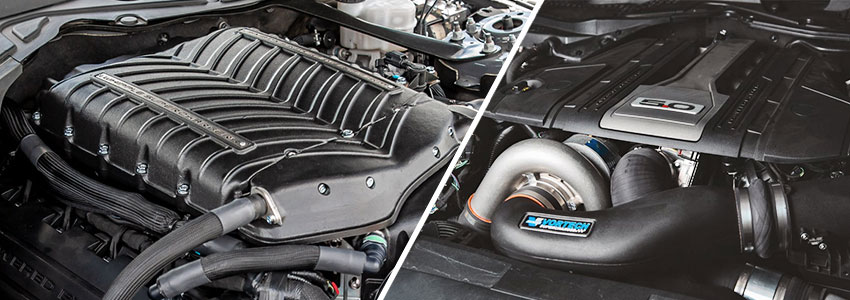
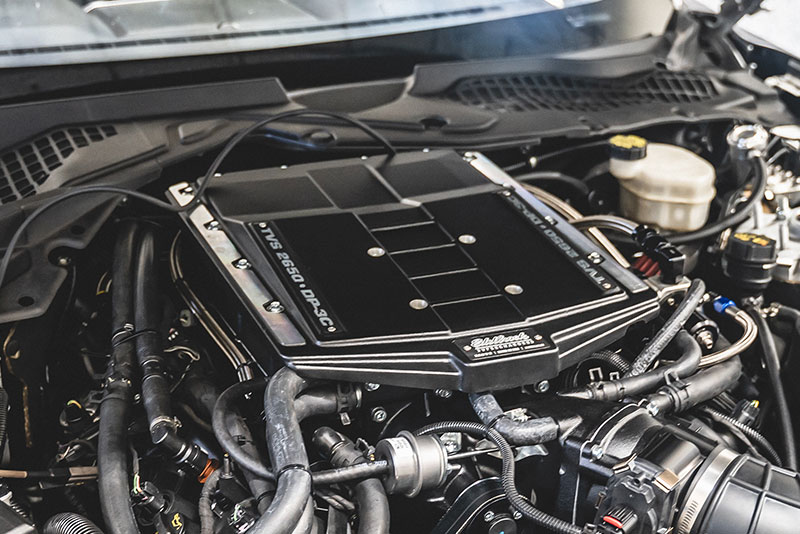
supercharger will directly make your car break since they come as fully prepared kits. The Roots blower is the classic, top-mounted supercharger, the one that comes to mind when you picture a
muscle car with a blower poking through the hood. It is a positive-displacement pump that uses
intermeshing, counter-rotating rotors to draw air and fuel from above the blower case and compress them
inside the case as the rotors spin. The payoff? Instant, flat boost. A Roots supercharger hits hard with torque right off idle and keeps
pulling all the way through the rev range, so power delivery is predictable and immediate. That makes it
perfect for street driving and off-the-line launches. Plus, since it bolts directly onto the engine,
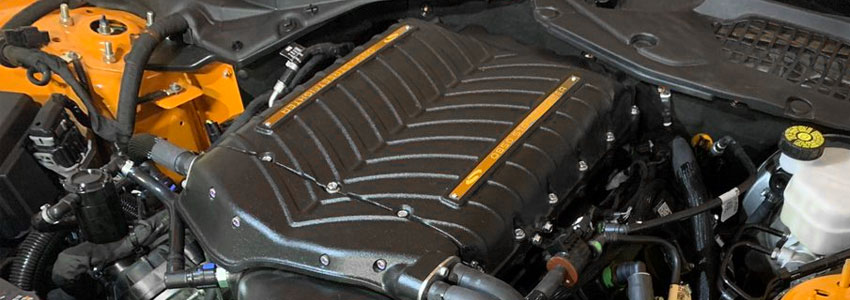
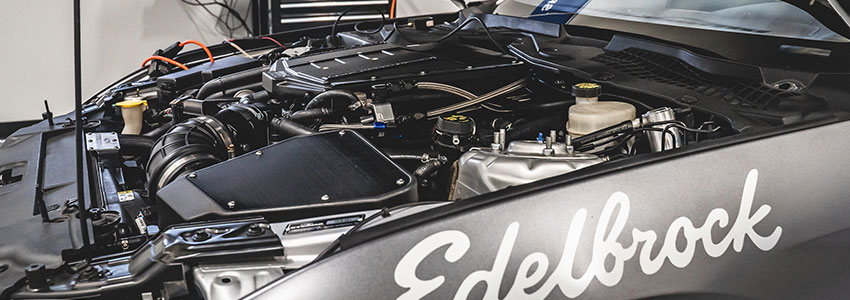
installation is usually straightforward. Edelbrock is a great company to watch in this space. Twin-screw superchargers are often grouped with Roots units since they're both positive-displacement and
mount up top, but there's a key difference in how they work. A twin-screw uses meshing helical rotors to
compress air inside the case before it enters the engine. That internal compression means more
efficiency and cooler charge temps compared to a Roots blower, especially as you turn up the boost. The result is the best of both worlds: instant, flat torque down low like a Roots, but with better
efficiency and cooler charge temps as the revs climb. That's why twin-screws are the go-to for owners
chasing big, street-friendly, reliable horsepower. Whipple is the standard-bearer here and has specialized in
twin-screw technology for decades; many kits include an integrated intercooler specifically to manage
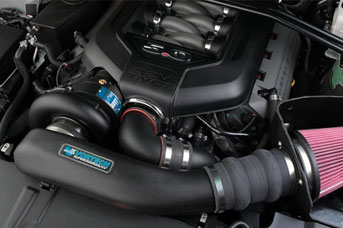
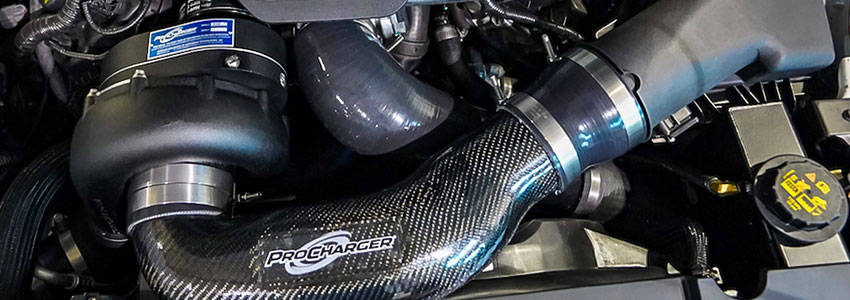
charge temps. A centrifugal supercharger has more in common with a turbo than a traditional blower. It's compact,
mounts up front or to the side, and runs on a belt and pulley rather than exhaust gases. Inside, a
high-speed impeller pulls in air and slings it outward to build boost. What really sets a centrifugal apart is the boost curve. Instead of a flat hit, boost builds with RPM,
coming on stronger as you climb through the revs and hitting hardest near redline. That's not a
drawback; it's just a different tool for the job. The progressive power delivery is easy to control on a
technical course, and since the unit isn't baking on top of the engine, centrifugals handle heat better
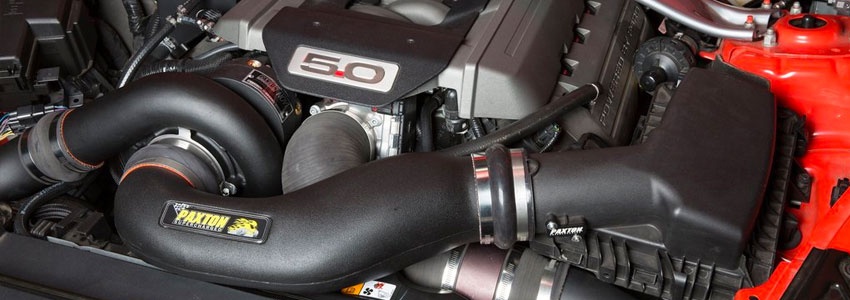
than the other types and work well with air-to-air intercoolers. There are more brands moving into this market than many other power-adder companies. Brands like Vortech,
Paxton, and ProCharger are the main brands in the
market, and each of them has a history in the
supercharger market.
With the two types of superchargers established, it is obvious that different types of superchargers will
have pros over the other
while also having major cons with them as well. With the roots-style or twin-screw supercharger, there
is a very obvious pro in the sense that the same level of power is generated throughout the rev range.
With this setup, the same amount of air is forced through the supercharger at any level which means a
driver can know what to expect. Additionally, these positive-displacement superchargers are a simple
bolt-on installation in many cases since they sit on top of the engine as opposed to the front-mounted
centrifugal supercharger systems. Unfortunately, these systems have some flaws in the sense of not being
able to bring in extra air after a certain point, as well as their weight and their vulnerability to
heat issues. While the benefits of the roots-style and twin screw superchargers seem to be numerous, centrifugal
superchargers do the same work and have more than enough benefits to understand why people want them
more often than the other setup. Unlike the roots-style supercharger, centrifugal superchargers are very
compact and lightweight and can be mounted on either side of the engine, similar to how a turbo mounts.
Additionally, like a turbo these superchargers spool as the engine revs, meaning that there is power at
any range but it takes time to reach peak performance. While this may seem like a negative, it also
allows the supercharger to run without a set limit on air that can be brought in which means it can
generate more power. These two types of superchargers serve very different purposes and must be taken into consideration
before installation on your engine. The two different types of superchargers have benefits at different
RPMs and how they pull as you drive. Those cars and trucks fitted with roots or twin-screw
superchargers, these cars can dominate during road racing and drag racing. Since these types of
superchargers will provide all of their available performance at once, they work well to put a lot of
power down instantly, which means a good launch and constant pull until the top end, as long as a
transmission will keep giving it room to run. A perfect example of this is with the Steeda Silver
Bullet which is fitted with the Edelbrock E-Force Stage 2 Supercharger. As a dedicated drag car, having all of
the necessary horsepower available so quickly helped us pass 8.45 in the quarter mile! With centrifugal systems like the ProCharger, you can use these around just about any type of racing.
Since these superchargers build boost gradually, it is easy to control around a narrow or technical
track like you'd find at autocross, as well as putting enough power down throughout the turns and
straightaways in track racing. When kept in the upper RPM range, these superchargers can make some of
the fastest cars on the strip since they will continue to bring in more and more air the faster they
run. For street driving and instant punch, it's tough to top a Roots or twin-screw. Full
boost lands almost right away, making the car feel eager at any RPM and with any stab of the
throttle—perfect for daily use and stoplight sprints. For drag racing, positive-displacement setups like Roots and twin-screw shine off the line,
delivering instant torque for hard launches and a steady pull down the strip. Centrifugals
can still put up big numbers, especially up top, but the launch feel is a different animal. On the autocross or road course, a centrifugal's progressive, RPM-driven boost is easy
to modulate through corners, and its ability to keep temps in check pays off lap after lap. Here, the
“builds with RPM” trait turns into a real advantage. Supercharger options depend on your Mustang's generation, and the landscape keeps evolving, so it's
important to match the right kit to your platform: Both are positive-displacement and deliver an instant, flat boost. The practical difference
is that a twin-screw compressor compresses air internally, making it more efficient and
cooler-running at a bigger boost, while a Roots blower is typically simpler and more
affordable. For higher power targets, twin-screw usually has the edge; for value and proven
simplicity, Roots is strong. It depends on the kit and the platform, but centrifugal and twin-screw systems generally
reach the highest peak numbers, centrifugals up top as RPM climbs, twin-screws through
efficient positive-displacement compression. Not in the turbo sense. A centrifugal is belt-driven, so it responds instantly, but its boost
builds with engine RPM rather than arriving flat from low RPM. Peak boost is near redline.
For everyday driving, most owners prefer a Roots or twin-screw for the instant low-end
torque. If you spend more time at the track or autocross, a centrifugal’s progressive,
cooler-running delivery may suit you better. Best Superchargers For 2011-2014 Mustangs Top Superchargers For The 2015-2021 Mustang Mustang Open vs Closed Lid Cold Air IntakesRoots vs. Twin-Screw vs. Centrifugal Superchargers: Which Is Best for Your Mustang?
Quick Comparison: Roots vs. Twin-Screw vs. Centrifugal
Roots
Twin-Screw
Centrifugal
Type
Positive Displacement
Positive Displacement
Dynamic (impeller)
Internal compression?
No, air is compressed in the manifold
Yes, compressed inside the case
Yes, compressed by impeller
Boost curve
Flat; near-full boost from low RPM
Flat; strong low-end, efficient up top
Builds with RPM; peaks near redline
Mounting
On top of the engine
On top of the engine
Front/side, turbo-style
Power feel
Instant, big low-end torque
Instant, broad torque
Linear pull, hardest hit up high
Heat behavior
Most prone to heat soak
Cooler than Roots (internal compression)
Coolest; intercooler/air-to-air friendly
Best for
Street, strip, instant grunt
Street/strip, max positive-displacement power
Autocross, road course, top-end pulls
Common Brands
Edelbrock
Whipple, Roush
Vortech, Paxton, ProCharger
How a Supercharger Works
Types of Superchargers
Roots Superchargers
Twin-Screw Superchargers
Centrifugal Superchargers
Pros & Cons Of Supercharger Types
Supercharger Uses
Which Supercharger Is Best for You?
What Supercharger Fits Your Mustang?
Frequently Asked Questions
Related Articles